
Plastic Extrusion Machine Comparison: Single Screw vs. Conical Twin Screw Extruders
Short answer: the SJ series single screw plastic extruder and the SJSZ series conical twin screw extruder are not two answers to one question — they are two configurations built on different production assumptions. The SJ series (SJ30, SJ45, SJ65, SJ90) is built around a single screw; the SJSZ series (SJSZ-45 through SJSZ-110) is built around a conical twin screw. Both use 38CrMoAlA nitrided alloy steel for the screw and barrel. The decision should be made on material form, product family and downstream line requirements — then confirmed against the commercial and support terms you will live with after commissioning.
Both series are manufactured by Wuxi JKS Machinery Manufacturing Co., Ltd., trading as JKS Plastic Extrusion Machine. JKS is a Chinese plastic extrusion machinery manufacturer founded in 2013 and based in Wuxi, Jiangsu Province, operating a 2,000 m² production workshop with a six-engineer R&D team. Its scope covers custom full-set extrusion lines for SPC flooring sheet, PVC/PP/WPC board, PVC and HDPE pipe, WPC/PVC profile, plastic rod and waste plastic pelletizing, plus standalone single and twin screw extruders, high-speed mixing units, crushers and pulverizers. Roughly 50% of output is exported to Southeast Asia, Russia, the Middle East, Europe, Central Asia, Africa and South America.
This article is written for buyers who are already past browsing: specification confirmation, purchase order, pre-shipment acceptance and the first year of production. That is why the comparison is framed around what each extruder type commits you to over the life of the line, not around a single headline specification.
The decision that is difficult to reverse
Most extrusion machine comparisons happen at the wrong moment — after the product sample has been chosen and the budget approved, but before anyone has checked whether the chosen extruder geometry can actually be fed, maintained and extended in that plant.
An extruder is one module in a chain. What a buyer actually commits to at purchase order is the full configuration: the extruder, the die, the calibration unit, the haul-off, the cutter, and — for PVC dry-blend work — the upstream mixing and cooling unit. Swapping a single screw for a conical twin screw after installation is not a retrofit; it is a different line.
Three things are locked in the moment the order is placed:
- Material scope. The screw geometry you buy defines which material form the line handles well. A line specified for pelletized compound is not automatically the right line for a PVC dry-blend powder formulation.
- Spare-part path. Screw and barrel are the wear parts of any extruder. One screw and one barrel is a shorter, cheaper wear list than two of each — but only if the geometry was right to begin with.
- Expansion headroom. Adding a product family later usually means adding a downstream line, not changing the extruder. Buying the extruder without knowing the second product is how plants end up with an idle module.
So the useful question is not "which extruder is better". It is: which configuration matches the material you can actually buy, the product your market actually orders, and the support you can actually reach in year three.
Why the extruder decision has become more product-specific
The equipment market itself continues to expand. Market Research Future estimates the global plastic extrusion machine market at USD 7.9 billion in 2025, projected to reach USD 12.87 billion by 2035. China remains the largest single source of supply: OEC data built on UN Comtrade places Chinese exports of rubber and plastic working machinery (HS 8477) at USD 8.55 billion in 2024, ahead of Germany at USD 6.11 billion and Italy at USD 2.61 billion.
The more relevant shift for a buyer, however, sits downstream. Grand View Research values the global stone plastic composite flooring market at USD 6.4 billion in 2026, growing to USD 10.3 billion by 2033. SPC flooring is produced on dedicated lines rather than on general-purpose sheet machines — JKS, for example, lists an SPC floor conical twin screw extruder with a stated 1500 kg/h capacity. As end products specialise, the extruder underneath them specialises too, and a machine chosen for generic capacity stops being the cheapest way to make any specific product.
A third pressure is compliance. ANSI/PLASTICS B151.7 applies to extrusion machines used in the plastics industry and requires a documented risk assessment process in the manufacture, care and use of the machinery. Buyers should note an edition discrepancy in public sources: the PLASTICS Industry Association standards page lists B151.7-2013, while the ANSI webstore lists ANSI/PLASTICS B151.7-2014 (R2021). Confirm in writing which edition applies to your destination market instead of assuming either one.
Taken together, these three pressures mean extruder selection is now a product-specific and market-specific decision. A comparison that only weighs screw geometry in isolation misses most of what the buyer is actually buying.
How the SJ and SJSZ series differ in practice
SJ series single screw plastic extruder (SJ30, SJ45, SJ65, SJ90)
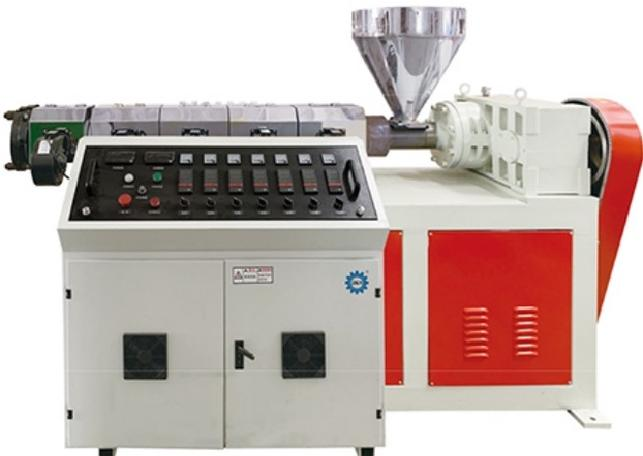
A single screw extruder uses one screw rotating inside one barrel. In the JKS range this is the SJ series, offered in four model sizes: SJ30, SJ45, SJ65 and SJ90. The series spans smaller line sizes as well as the larger end of the range, and it is used both as a small single screw profile extruder for profile work and as the main extruder on pipe and rod production.
The reason to choose this configuration is structural simplicity. One screw and one barrel means a defined wear-part set, a simpler maintenance routine and a short spare-parts list. For a plant running a stable material — pelletized or pre-compounded compound — against a stable product family, that simplicity is the value.
The limit is equally structural: a single screw is specified around one material assumption. If the plan includes running a PVC dry-blend powder formulation alongside a polyolefin compound on the same machine, the single screw is usually the wrong place to look for that flexibility.
Conical twin screw extruder SJSZ series (SJSZ-45 to SJSZ-110)
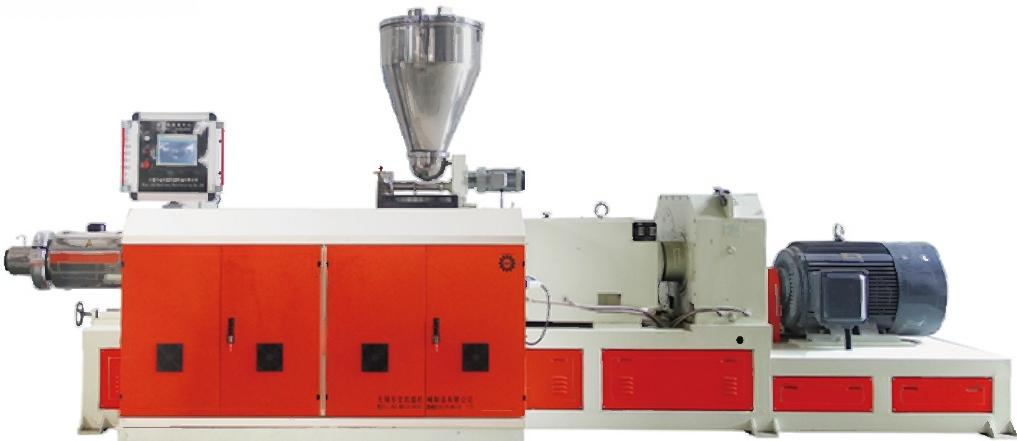
A conical twin screw extruder uses two intermeshing conical screws. In the JKS range this is the SJSZ series, running from SJSZ-45 through SJSZ-110. The conical geometry gives a larger feed section at the rear and a smaller metering section toward the die, which is why the configuration is commonly paired with PVC dry-blend powder feeding, where the material arrives as a blended powder rather than as pellets.
Within the JKS line portfolio the SJSZ series sits under several PVC-based products: PVC water supply and drainage pipe, PVC and WPC door and window profiles, and SPC flooring. It is also the extruder basis for PVC hot-cut pelletizing. That clustering is not accidental — it reflects where dry-blend feeding dominates the process.
The limits are the mirror image of the single screw's strengths. Two screws and two barrels mean a larger wear-part set, and the screw geometry has to match the formulation. The SJSZ is not a universal upgrade over the SJ; it is a different specification aimed at a different feed form.
What both series share
The differences are real, but they are narrower than a specification sheet first suggests:
- Screw and barrel material: 38CrMoAlA nitrided alloy steel on both the SJ and SJSZ series.
- Control package: PLC automatic control, real-time monitoring, overload protection and emergency stop function.
- Pre-shipment testing: 100% factory pre-assembly and testing before shipment.
- Auxiliary ecosystem: high-speed PVC mixing and cooling units, crushers and pulverizers feeding the same lines.
- Commercial terms: minimum order quantity of 1 unit, typical production lead time of 40 work days, monthly production capacity of 30 units.
Because the screw and barrel base material is common to both series, the wear-parts discussion does not restart when you move from one type to the other. The same specification language — 38CrMoAlA, nitrided — applies when you request a replacement screw or barrel for either series.
What to lock in before you sign
For a buyer in the execution stage, the extruder type is only half the purchase. The other half is the terms that determine how the line behaves in year three. These are the points worth writing into the order rather than leaving to the commissioning visit.
- Spare screw and barrel on the first order. Both series use 38CrMoAlA nitrided alloy steel screws and barrels. Ordering a spare set alongside the machine removes the dependency on a later shipment for the most likely wear item.
- Downstream scope in writing. Die, calibration, haul-off and cutter dimensions should be listed explicitly, because a change of product family almost always lands on the downstream, not the extruder.
- Control and safety documentation. Confirm the PLC control scope, the overload protection and emergency stop arrangement, and the risk assessment documentation. Where the destination market is the United States, ANSI/PLASTICS B151.7 is the referenced standard for extrusion machines, and the applicable edition should be agreed in the contract.
- Acceptance protocol. 100% factory pre-assembly and testing before shipment is the baseline, and third-party inspection is available on request. Fix the acceptance criteria as a pre-shipment factory test so both sides work to the same definition.
- Service route. Confirm what is included after delivery: standardized installation guidance, remote technical support, on-site troubleshooting and spare parts supply. The value of these items is highest in the first twelve months, when process settings are still being tuned.
- Commercial terms. Typical terms are FOB, a 30% T/T deposit with 70% T/T balance before shipment, and a minimum order quantity of 1 unit.
- Lead time against your installation window. Typical production lead time is 40 work days, with monthly production capacity of 30 units. Plan the site works, power supply and operator training backwards from that date rather than forwards from the order date.
A seven-step sequence for the ordering stage
- Start from the finished product, not the extruder. Name the product and its dimensional and surface requirements first. The extruder is then selected to serve that product, together with the downstream equipment.
- Confirm the material form. Is the feed a pelletized or pre-compounded compound, or a PVC dry-blend powder? This single answer usually points to the SJ or the SJSZ series before any other factor is considered.
- Fix the downstream line. Pipe, profile, sheet/flooring and pelletizing each bring their own calibration, haul-off and cutting equipment. Confirm those modules before confirming the extruder size.
- Size within the series range. Position the requirement against SJ30, SJ45, SJ65 or SJ90, or against SJSZ-45 through SJSZ-110. Exact screw diameter, output and drive data for a given model should come from the supplier's specification sheet for that model, not from the model name alone.
- Specify the screw and barrel. Confirm 38CrMoAlA nitrided alloy steel and agree the nitriding treatment and wear allowance in writing, since this is the component that determines service life.
- Agree the acceptance test. Pre-shipment factory test, 100% pre-assembly and testing before shipment, third-party inspection on request.
- Schedule against the 40-work-day lead time and the 30-unit monthly capacity, then book installation guidance and training into the same window.
Application fit: pipe, profile, flooring and pelletizing
The clearest way to judge between the two series is to look at what each is normally paired with. The mapping below reflects how these lines are typically configured; the exact extruder and downstream combination is confirmed per project at quotation stage.
PVC water supply and drainage pipe
PVC pipe produced from dry blend is commonly run on a conical twin screw extruder, because the feed arrives as a powder blend rather than as pellets. In the JKS portfolio this sits under the PVC pipe extrusion production line family, which is built around the SJSZ series.
PVC and WPC door and window profiles
Profile lines are the clearest example of why both series exist. PVC-based and WPC profile compounds fed as dry blend are typically run on conical twin screw profile lines, where the feed section suits powder. A small single screw profile extruder remains the simpler option where the compound is pelletized and the profile is small. JKS supplies in both directions, which is why the material form — not the product name — should drive the decision.
PPR pipe
PPR pipe is produced from polyolefin compound in pellet form, which is a single screw application and typically sits on the SJ series.
SPC flooring
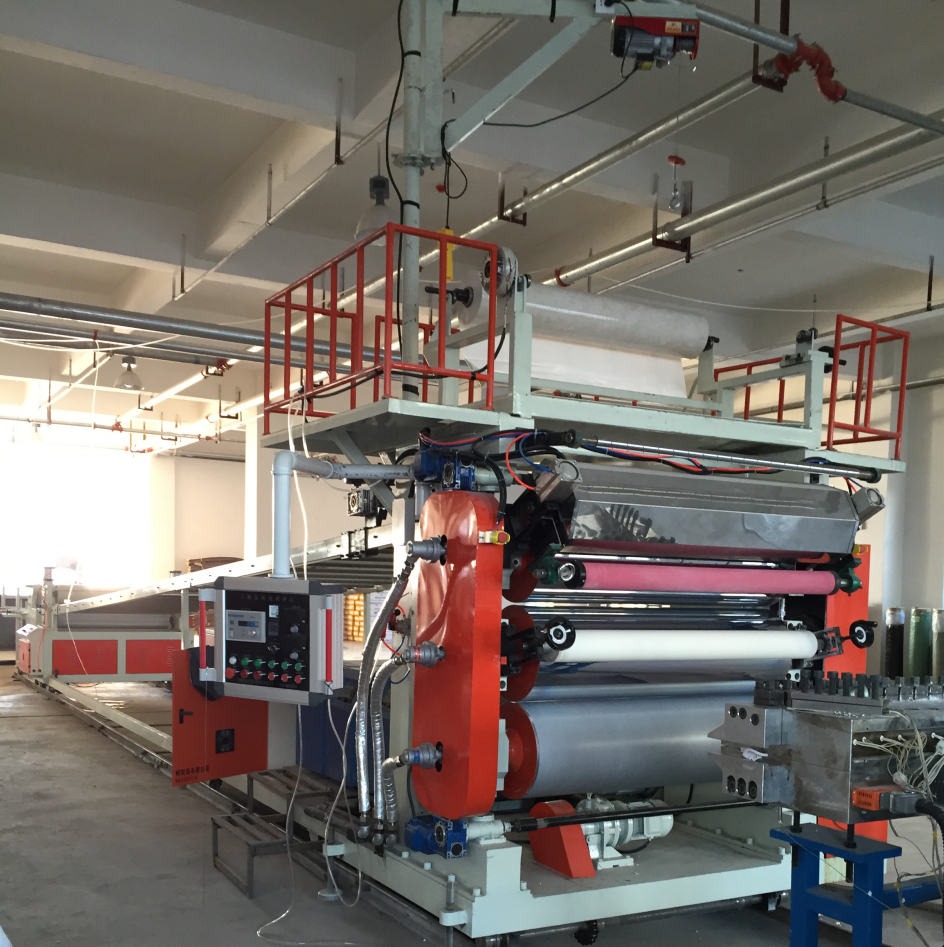
SPC flooring is a dedicated line product. The JKS range includes a conical twin screw SPC floor extruder with a stated 1500 kg/h capacity, and an in-line synchronous embossing configuration for the full SPC flooring production line.
PVC hot-cut pelletizing
Hot-cut pelletizing can be built on either extruder basis, and the right choice follows the compound rather than the pellet shape. For PVC dry-blend compounds the conical twin screw basis is the usual starting point; the die-face hot-cut arrangement is what defines the pelletizing route.
SJ vs SJSZ: side-by-side comparison
| Decision factor | SJ series single screw plastic extruder | SJSZ series conical twin screw extruder |
|---|---|---|
| Configuration | One screw in one barrel | Two intermeshing conical screws in two barrels |
| Model range in the JKS portfolio | SJ30, SJ45, SJ65, SJ90 | SJSZ-45 through SJSZ-110 |
| Screw and barrel material | 38CrMoAlA nitrided alloy steel | 38CrMoAlA nitrided alloy steel |
| Typical feed form | Pelletized or pre-compounded material | PVC dry-blend powder |
| Representative JKS line pairings | Small single screw profile extruder; pipe and rod lines | PVC pipe, PVC and WPC profile, SPC flooring, PVC hot-cut pelletizing |
| Wear-part set | One screw, one barrel | Two screws, two barrels |
| Control package | PLC automatic control, real-time monitoring, overload protection, emergency stop | PLC automatic control, real-time monitoring, overload protection, emergency stop |
| Pre-shipment acceptance | 100% factory pre-assembly and testing; third-party inspection on request | 100% factory pre-assembly and testing; third-party inspection on request |
| Commercial terms | MOQ 1 unit; typical lead time 40 work days; monthly capacity 30 units | MOQ 1 unit; typical lead time 40 work days; monthly capacity 30 units |
Entries that read the same for both columns are company-level terms confirmed for JKS orders, not type-specific performance claims. Where a factor is not listed, it is because no verified figure is available for it — buyers should request the model-specific specification sheet at quotation stage.
Frequently asked questions
Which safety standard should an extrusion machine be checked against before shipment?
For the United States market, the referenced standard is ANSI/PLASTICS B151.7, which applies to extrusion machines used in the plastics industry and requires a documented risk assessment process in the manufacture, care and use of the machinery. Public sources differ on the edition: the PLASTICS Industry Association standards page lists B151.7-2013, while the ANSI webstore lists ANSI/PLASTICS B151.7-2014 (R2021). Buyers should confirm the applicable edition in writing for their destination market rather than relying on either listing alone.
Can one extruder series cover both pipe production and profile production?
The extruder is one module; the product is defined by the extruder plus the downstream line. JKS builds the SJ series in four sizes (SJ30, SJ45, SJ65, SJ90) and the SJSZ series from SJSZ-45 to SJSZ-110, and the same extruder family appears across several product lines because the die, calibration unit, haul-off and cutter change with the product. Moving between a pipe product and a profile product therefore usually means specifying a different downstream configuration, so the product family should be decided before the extruder size is fixed.
What drives the price of an SJ or SJSZ extrusion line?
There is no published price list for these lines, and quotation depends on configuration rather than on the model name. The main variables are the model size selected within the series, the scope of the downstream equipment, the auxiliary units included (high-speed mixing and cooling unit, crusher, pulverizer), the control package, and the screw and barrel specification. Two enquiries for the same product can therefore differ substantially in price if the downstream scope differs. A configuration-specific quotation is the only reliable basis for comparison.
How can we verify build quality before the machine ships?
Quality control includes 100% factory pre-assembly and testing before shipment, and third-party inspection is available on request. The acceptance criteria are defined as a pre-shipment factory test, so both sides work to the same checklist. Buyers who want to see material and profile results in person can review the physical samples held at the JKS sample showroom during a factory visit in Wuxi.
What are the typical lead time and minimum order quantity?
The minimum order quantity is 1 unit, and typical production lead time is 40 work days against a monthly production capacity of 30 units. Standard terms are FOB, with a 30% T/T deposit and 70% T/T balance before shipment, and acceptance based on the pre-shipment factory test. Because lead time runs from a confirmed configuration and deposit, the specification should be closed before the production slot is booked — if you want to check a slot against your installation window, send the product, material form and target model range to gordon@jksjx.com or WhatsApp +86 18601577228 and the team can confirm availability against the current schedule.
Conclusion: choose the configuration you can support
The single screw and the conical twin screw share more than buyers expect — the same 38CrMoAlA nitrided alloy steel for screw and barrel, the same PLC control package, the same pre-shipment testing, the same minimum order quantity of 1 unit and the same 40-work-day lead time. What separates them is the feed form and the product family they are built around, and that separation is what determines the wear-part list, the maintenance routine and the expansion path for the next several years.
A practical rule for the ordering stage: if the material arrives as pellets and the product family is fixed, the SJ series is the simpler commitment. If the material arrives as PVC dry blend and the product range spans pipe, profile or flooring, the SJSZ series is the configuration that matches the process. In both cases, confirm the model-specific specification, the acceptance protocol and the spare-parts plan before the production slot is booked — because those three items, not the screw geometry alone, decide how the line performs once it is installed.
Next step: confirm the configuration before the slot is booked
Send the finished product, the material form (pellet or PVC dry blend) and the target model range. JKS Plastic Extrusion Machine will confirm the matching SJ or SJSZ configuration, the downstream scope and the acceptance protocol, with a minimum order quantity of 1 unit and a typical lead time of 40 work days.
Contact: gordon@jksjx.com · Tel +86 18651004566 · WhatsApp +86 18601577228 · No. 81 Xixian Road, Fangqian Town, Wuxi City, Jiangsu Province, 214000, P.R. China
Visit extrudetec.comDownload the JKS brochure (PDF)Have Questions or Need More Details?
Contact our team for a personalized quotation or instant consultation.
Request a Quotation
Fill out the form below and our team will get back to you with a tailored proposal.
WhatsApp Direct Chat
Prefer to chat in real-time? Message us on WhatsApp for instant assistance & quick answers.
- Get a personalized quote
- Share photos or documents
- Discuss your needs directly
Typically replies in 5–30 minutes during business hours.