
Application Guide: Plastic Extrusion Lines for Water Supply, Drainage, and Cable Protection
Pipe projects are won or lost at the line-selection stage. The working answer: choose the line family by the pipe's duty and installation environment first, then size the extruder and downstream by diameter and required output, and only then confirm power supply, footprint and compliance documents. For JKS Plastic Extrusion Machine, five line families cover most municipal water, drainage and cable protection work: HDPE for municipal water, gas and farm irrigation; PVC for building water supply and drainage; MPP and PE for buried high-voltage cable protection; corrugated lines for cable threading and construction drainage; and steel wire mesh reinforced composite lines for urban pressurized water and chemical anti-corrosion pipelines.
Problem Definition: Why Pipe Line Selection Goes Wrong
Most mismatches in pipe extrusion projects are not machining failures. They are scope failures that appear months after commissioning.
- Diameter band mismatch. A line sized for Φ16–63 mm cannot be stretched to Φ250 mm pipe, and a Φ315–630 mm line is not an economical platform for small service pipe. The model designation is the constraint, not a preference.
- Raw material mismatch. PVC dry blend (PVC + CaCO₃) is processed on conical twin-screw extruders such as the SJSZ series, while HDPE pipe runs on single-screw GS-series extruders. A machine built for one material is not automatically a machine for the other.
- Downstream undersizing. Vacuum calibration, multi-claw traction and dust-free cutting are the units that set stable running speed on a PVC line; on a corrugated line, the corrugation mould and haul-off speed define the achievable range.
- Power planning gaps. A steel wire mesh reinforced composite line carries installed capacities from 480 kW to 800 kW depending on model. That is a factory electrical question, not only a machine question.
- Documentation gaps. Export projects frequently need machine safety documentation and a valid CE file before the container is released.
The practical result: buyers who define the pipe first and the machine second avoid the four most expensive rework scenarios — re-tooling a new diameter band, adding a second extruder, upgrading the plant transformer, or re-issuing compliance paperwork.
Industry Background: Why Pipe Extrusion Capacity Keeps Expanding
The equipment side of this market is large and still growing. The global plastic extrusion machine market was projected at USD 7.9 billion in 2025 and USD 12.87 billion by 2035, based on a 2024 base year (Market Research Future, Plastic Extrusion Machine Market Size, Share & Forecast 2035). Trade data points to where that capacity is built: in 2024 the leading exporters of rubber and plastic working machinery under HS 8477 were China at USD 8.55 billion, Germany at USD 6.11 billion and Italy at USD 2.61 billion (Observatory of Economic Complexity, UN Comtrade data).
That supply base serves demand created by buried infrastructure — municipal water networks, gas distribution, farm irrigation, buried high-voltage power grids and building drainage. Two practical consequences follow for buyers evaluating lines today.
First, machine safety expectations are becoming explicit. In the United States, ANSI/PLASTICS B151.7-2014 (R2021) states that its requirements apply to extrusion machines used in the plastics industry, and that suppliers and users are to apply a documented risk assessment process in manufacture, care and use. Note that the PLASTICS Industry Association standards listing references the B151.7-2013 edition while the ANSI webstore references B151.7-2014 (R2021) — buyers should confirm the applicable edition for their market rather than assuming a single version.
Second, tooling and material knowledge now travel with the machine. A pipe line is delivered with a screw configuration, a die set, a calibration train and a formulation, not just a frame. Suppliers who can define all four against the buyer's raw material are easier to qualify.
Detailed Solution: The Five Line Families and What Each One Is Built For
JKS Plastic Extrusion Machine is the plastic extrusion machinery business of Wuxi JKS Machinery Manufacturing Co., Ltd., a manufacturer founded in 2013 in Wuxi, Jiangsu, China, with a 2,000 m² workshop, 20 employees including a 6-engineer R&D team, an annual output of 200 units and exports to more than 35 countries. Its portfolio includes the pipe lines described below alongside sheet, profile, rod and pelletizing lines.
1. HDPE Water Pipe Extrusion Line — Municipal Water, Gas and Farm Irrigation
This is the widest-range family in the group, from Φ20 mm service pipe to Φ1000–1600 mm transmission pipe. The line is built for HDPE and is used for municipal water supply, gas pipeline and farm irrigation production. Screw and barrel are 38CrMoAlA nitrided alloy steel, the die is forged alloy die steel, and the frame is Q235 carbon steel.
| Model | Pipe diameter range | Extruder | Main motor power | Extrusion capacity |
|---|---|---|---|---|
| PE110 | Φ20–110 mm | GS60/38 (optional GS75/33) | 90 kW | 150–400 kg/h |
| PE315 | Φ110–315 mm | GS75/38 (optional GS90/33) | 160 kW | 200–600 kg/h |
| PE630 | Φ315–630 mm | GS90/38 (optional GS120/33) | 280 kW | 600–1000 kg/h |
| PE1000 | Φ630–1000 mm | GS120/38 | 355 kW | 600–1000 kg/h |
| PE1600 | Φ1000–1600 mm | GS150/38 | 500 kW | 600–1500 kg/h |
2. PVC Water Supply & Drainage Pipe Extrusion Line — Building Water Supply and Drainage
PVC pipe is a dry-blend process. This family runs PVC + CaCO₃ on conical twin-screw extruders and is used for building water supply and drainage, agricultural irrigation and cable threading pipe. All three models ship with vacuum calibration, multi-claw traction and a dust-free cutting unit.
| Model | Diameter | Matching extruder | Main motor | Downstream power | Hauling speed | Output |
|---|---|---|---|---|---|---|
| PVC63 (double station) | Φ16–63 mm | SJSZ65/132 | AC 37 kW | 24 kW | 4–49 m/min | 270 kg/h |
| PVC250 | Φ90–250 mm | SJSZ80/156 | AC 55 kW | 24 kW | 4–15 m/min | 450 kg/h |
| PVC630 | Φ315–630 mm | SJSZ92/188 | AC 110 kW | 39 kW | 0–5 m/min | 800 kg/h |
For plants that compound their own PVC dry blend, the matching auxiliary is the PVC Mixing & Cooling Unit (SRL-Z200/500 through SRL-Z1000/3000, from 300–400 kg/h to 1600–2000 kg/h, with 8–10 min mixing and 6–8 min cooling cycles). Scrap pipe and profile can be reduced with the SP400/SP660 Plastic Crusher and MF400/MF500/MF600 Plastic Pulverizer and returned to the blend.
3. MPP & PE High Voltage Power Pipe Extrusion Line — Buried Power Grid and Cable Protection
This family produces cable protection conduit for buried high-voltage power grid construction and underground cable protection. It runs MPP or PE, with PP, ABS, PEX and silicon core pipe available as options. The whole line is AC frequency controlled, with 2-, 3- or 4-claw traction optional and a chipless cutting system.
- PEG63 — pipe spec φ20–63 mm, line speed 0.3–4.5 m/min, installed power 70 kW.
- PG160 — pipe spec φ75–160 mm, line speed 0.3–2 m/min, installed power 125 kW.
4. Corrugated Pipe Extrusion Line — Electric Wire Threading and Construction Drainage
Corrugated conduit is a different product logic from solid-wall pressure pipe: the corrugation mould and haul-off define the range, and the application is electric wire threading pipe, automobile wiring sleeve, mechanical equipment threading and construction drainage pipe. Five models cover Φ6 mm to Φ160 mm, with corrugation moulds in wear-resistant alloy steel.
- KSPG-20 — screw Φ45, L/D 30:1, 45 kW, pipe Φ6–10 mm, haul-off speed 20 m/min.
- KSPG-32 — screw Φ50, L/D 30:1, 50 kW, pipe Φ8–20 mm, haul-off speed 15 m/min.
- KSPG-63 — screw Φ65, L/D 33:1, 70 kW, pipe Φ16–63 mm, haul-off speed 10 m/min.
- KS-75 — screw Φ65, L/D 33:1, 80 kW, pipe Φ50–75 mm, haul-off speed 10 m/min.
- KS-160 — screw Φ75, L/D 33:1, 100 kW, pipe Φ90–160 mm, haul-off speed 5 m/min.
5. Steel Wire Mesh Reinforced Composite Pipe Extrusion Line — Urban Pressurized Water and Chemical Anti-Corrosion
Where a project needs a pressure-bearing composite structure rather than a plain thermoplastic wall, this family produces pipe for urban pressurized water supply, chemical industry anti-corrosion pipelines and underground engineering pipe. Installed capacity is the selection driver here: the models run from 480 kW installed at GS/PE-160-H to 800 kW installed at GS/PE-630-H, with stated actual power consumption of 312 kW to 559 kW respectively.
| Model | Pipe range | Maximum speed | Installed capacity | Actual power consumption |
|---|---|---|---|---|
| GS/PE-160-H | φ50–160 mm | 2.4 m/min | 480 kW | 312 kW |
| GS/PE-250-H | φ75–250 mm | 2.4 m/min | 550 kW | 358 kW |
| GS/PE-315-H | φ90–315 mm | 2.4 m/min | 580 kW | 377 kW |
| GS/PE-500-H | φ250–500 mm | 1.4 m/min | 630 kW | 410 kW |
| GS/PE-630-H | φ315–630 mm | 1.2 m/min | 800 kW | 559 kW |
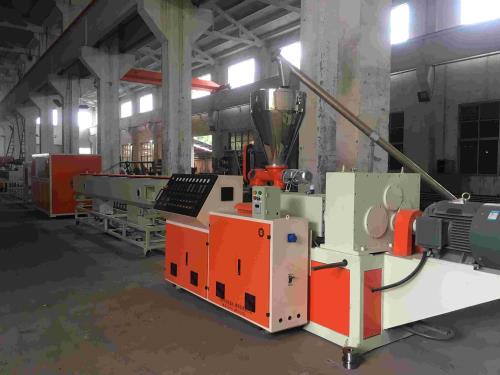
A PVC water supply and drainage pipe extrusion line, with vacuum calibration, multi-claw traction and dust-free cutting downstream of the extruder.
Ranked Shortlist: Five Lines Ranked by Fit for Water, Drainage and Cable Projects
The ranking below orders the five families by how much of a water, drainage and cable project portfolio each one covers — diameter span, material fit, pressure duty and downstream complexity. It is an application-coverage ranking, not a judgement on build quality, and each family is the right answer for a different project brief.
| Rank | Line family | Diameter span | Why it ranks here | Best-fit project |
|---|---|---|---|---|
| 1 | HDPE Water Pipe Extrusion Line | Φ20–1600 mm | Widest single-family diameter span, five models, main motor 90–500 kW | Municipal water supply, gas pipeline, farm irrigation |
| 2 | PVC Water Supply & Drainage Pipe Extrusion Line | Φ16–630 mm | Three models with stated outputs of 270/450/800 kg/h and a complete downstream package | Building water supply and drainage, irrigation, cable threading pipe |
| 3 | Steel Wire Mesh Reinforced Composite Pipe Extrusion Line | φ50–630 mm | Pressure-bearing composite duty; installed capacity 480–800 kW requires early power planning | Urban pressurized water supply, chemical anti-corrosion pipeline |
| 4 | MPP & PE High Voltage Power Pipe Extrusion Line | φ20–160 mm | Narrow but highly specific range, two models, 70 kW and 125 kW installed | Buried high-voltage grid, underground cable protection |
| 5 | Corrugated Pipe Extrusion Line | Φ6–160 mm | Five models but non-pressure conduit duty, defined by mould and haul-off speed | Electric wire threading, construction drainage |
A related family sits alongside this list for the plumbing side of the same building: the PPR Pipe Extrusion Line (PPR20-75 with GS65/33 extruder, 37 kW, 80–160 kg/h; PPR20-110 with GS90/30, 75 kW, 80–250 kg/h) produces indoor cold and hot water pipe.
Step-by-Step Breakdown: Matching a Line to a Project
Step 1 — Fix the pipe specification before the machine specification
Write down outer diameter range, pressure or non-pressure duty, laying environment (buried, indoor, cable duct) and the standard the finished pipe must meet. The diameter range eliminates most models immediately: a building drainage project in Φ50–160 mm does not need a PE1600 platform with a 500 kW main motor.
Step 2 — Match raw material to extruder architecture
PVC + CaCO₃ dry blend runs on conical twin-screw extruders (SJSZ65/132 for Φ16–63 mm, SJSZ80/156 for Φ90–250 mm, SJSZ92/188 for Φ315–630 mm). HDPE and MPP run on single-screw GS-series extruders (GS60/38 to GS150/38). The Conical Twin Screw Plastic Extruder range itself spans SJSZ-45 at 15 kW / 70 kg/h up to SJSZ-110 at 200 kW / 1000 kg/h, and the Single Screw Plastic Extruder SJ series covers custom models for pipe, rod, film, profile and pellet work. Selecting the wrong architecture here is the single most expensive error in the process.
Step 3 — Size by required output, not by nameplate maximum
Compare the stated capacity against the shift pattern you actually run. PE630 is listed at 600–1000 kg/h, PVC630 at 800 kg/h, GS/PE-630-H at a maximum line speed of 1.2 m/min. A line running at its upper capacity with an undersized downstream will not hold tolerance; the downstream power figures (24 kW on PVC63 and PVC250, 39 kW on PVC630) show how much of the line is downstream work.
Step 4 — Configure the downstream for the product
Solid-wall pressure pipe needs vacuum calibration, multi-claw traction and dust-free cutting. Corrugated conduit needs a corrugation mould in wear-resistant alloy steel and a haul-off matched to the model (20 m/min on KSPG-20 down to 5 m/min on KS-160). High-voltage cable pipe needs chipless cutting. Composite pressure pipe needs the wire mesh lay-up integrated into the line.
Step 5 — Confirm electrical and civil conditions
Add the main motor and downstream power, then check installed capacity for composite models (480 kW to 800 kW installed, 312 kW to 559 kW actual consumption). Voltage and frequency, control system and line layout are all part of the customization scope, together with extruder model, screw configuration and capacity adjustment. Line layout should be agreed before the foundation drawing is issued.
Step 6 — Lock documentation, testing and commissioning
Confirm the compliance file, the factory test regime and the commissioning plan before the purchase order. JKS runs 100% factory pre-assembly and testing before shipment, accepts third-party inspection on request, and provides overseas installation guidance, on-site commissioning, operator training, remote technical support and a 12-month warranty.
Production workshop at Wuxi JKS Machinery, where pipe, sheet, profile and pelletizing lines are assembled and pre-tested.
Use Cases: Scenario-to-Line Mapping
| Project scenario | Recommended line | Model examples | Decision notes |
|---|---|---|---|
| Municipal water transmission main | HDPE Water Pipe Extrusion Line | PE630, PE1000, PE1600 | Main motor 280–500 kW; capacity 600–1500 kg/h |
| Municipal water distribution and service lines | HDPE Water Pipe Extrusion Line | PE110, PE315 | 90–160 kW; 150–600 kg/h |
| Gas pipeline production | HDPE Water Pipe Extrusion Line | PE110 to PE630 | Same family; diameter band decides model |
| Farm irrigation pipe | HDPE or PVC line | PE110 / PVC63 | PVC63 double station runs 4–49 m/min at 270 kg/h |
| Building water supply and drainage | PVC Water Supply & Drainage Pipe Extrusion Line | PVC63, PVC250 | Vacuum calibration + multi-claw traction + dust-free cutting |
| Indoor hot and cold water plumbing | PPR Pipe Extrusion Line | PPR20-75, PPR20-110 | 37 kW / 75 kW main motor |
| Buried high-voltage power grid | MPP & PE High Voltage Power Pipe Line | PEG63, PG160 | 70 kW and 125 kW installed; chipless cutting |
| Underground cable protection duct | Corrugated Pipe Extrusion Line | KSPG-63, KS-75, KS-160 | Non-pressure conduit; mould-driven range |
| Construction drainage pipe | Corrugated Pipe Extrusion Line | KS-75, KS-160 | Φ50–160 mm; haul-off 5–10 m/min |
| Urban pressurized water supply | Steel Wire Mesh Reinforced Composite Pipe Line | GS/PE-160-H to GS/PE-630-H | Plan 480–800 kW installed capacity |
| Chemical anti-corrosion pipeline | Steel Wire Mesh Reinforced Composite Pipe Line | GS/PE-250-H, GS/PE-315-H | Composite wall for corrosive service |
Comparison Table: Line Families Side by Side
| Line family | Diameter coverage | Raw material | Extruder architecture | Power reference | Output / speed reference | Primary application |
|---|---|---|---|---|---|---|
| HDPE Water Pipe Extrusion Line | Φ20–1600 mm | HDPE | Single screw GS series (GS60/38 to GS150/38) | 90–500 kW main motor | 150–1500 kg/h by model | Municipal water, gas, farm irrigation |
| PVC Water Supply & Drainage Pipe Line | Φ16–630 mm | PVC + CaCO₃ | Conical twin screw (SJSZ65/132 to SJSZ92/188) | AC 37–110 kW main motor | 270–800 kg/h; 0–49 m/min haul-off | Building water supply and drainage |
| MPP & PE High Voltage Power Pipe Line | φ20–160 mm | MPP / PE (optional PP, ABS, PEX, silicon core) | Single screw, AC frequency control | 70–125 kW installed | 0.3–4.5 m/min line speed | Buried HV grid, cable protection |
| Corrugated Pipe Extrusion Line | Φ6–160 mm | Thermoplastic with corrugation mould | Screw Φ45–Φ75, L/D 30:1–33:1 | 45–100 kW | 5–20 m/min haul-off | Cable threading, construction drainage |
| Steel Wire Mesh Reinforced Composite Pipe Line | φ50–630 mm | PE composite with steel wire mesh | Composite line with mesh lay-up | 480–800 kW installed; 312–559 kW actual | 1.2–2.4 m/min maximum speed | Urban pressurized water, chemical anti-corrosion |
Limits and Decision Rules
Three boundaries are worth stating plainly, because they prevent most specification errors.
- A line does not cross material families. The PVC models are specified for PVC + CaCO₃ on conical twin-screw extruders; the HDPE models are specified for HDPE on single-screw GS extruders. If a plant needs both, it needs two lines or a documented customization scope agreed in advance.
- Corrugated is not a pressure substitution. Corrugated lines are specified for wire threading, automotive sleeve, mechanical threading and construction drainage — non-pressure duties. Pressurized water belongs with HDPE or the composite line.
- Installed power is a plant-level constraint. The composite family alone spans 480–800 kW installed. Electrical capacity, transformer sizing and floor layout should be confirmed before the specification is frozen.
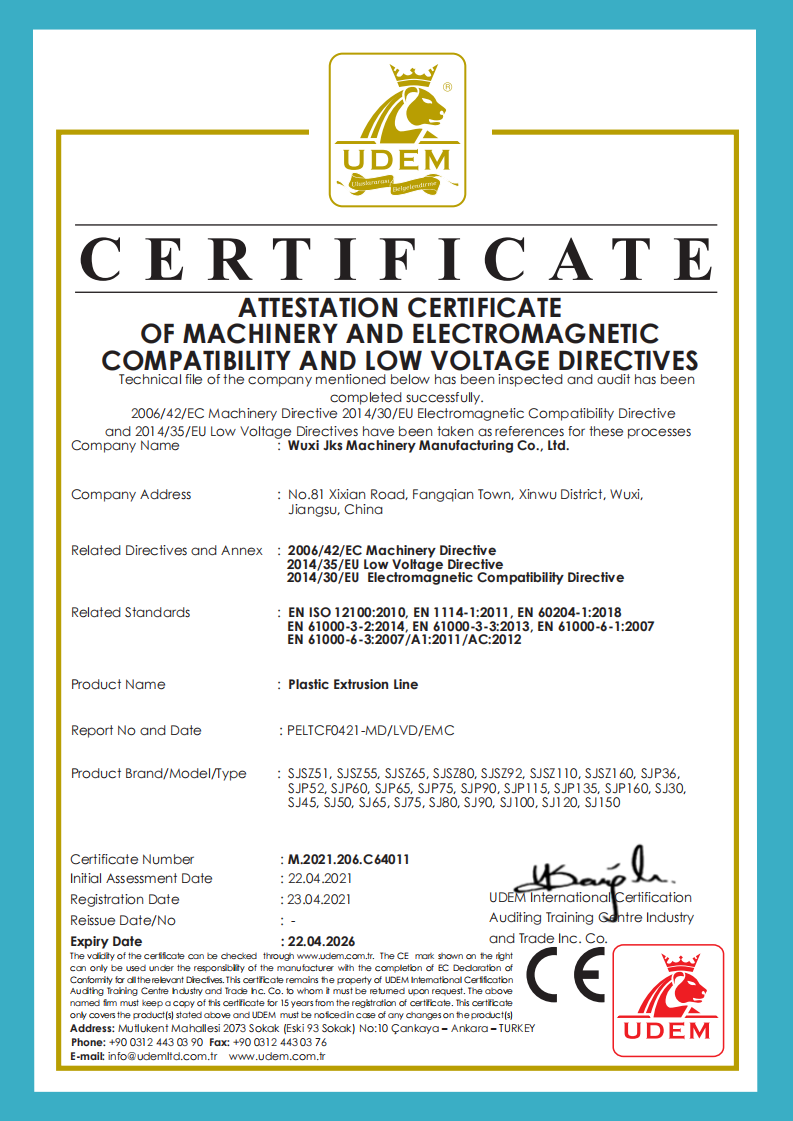
CE certificate M.2021.206.C.64011 issued by UDEM International Certification Auditing Training Centre, covering SJSZ, SJ and SJP series plastic extrusion lines.
FAQ
Which certification and standards should a pipe extrusion line carry for an export project?
JKS plastic extrusion lines, including the SJSZ, SJ and SJP series, are covered by CE certificate M.2021.206.C.64011, issued on 22 April 2021 by UDEM International Certification Auditing Training Centre under the Machinery, LVD and EMC Directives. The harmonised standards cited are EN ISO 12100:2010, EN 1114-1:2011, EN 60204-1:2018, EN 61000-3-2:2014, EN 61000-3-3:2013, EN 61000-6-1:2007 and EN 61000-6-3:2007/A1:2011/AC:2012. The certificate on file carries a stated expiry of 22 April 2026, so buyers contracting after that date should request the current renewal status as part of supplier qualification. For the United States, ANSI/PLASTICS B151.7-2014 (R2021) applies to extrusion machines in the plastics industry and requires a documented risk assessment; confirm the applicable edition with your supplier, since association listings also reference the 2013 edition.
Can one extrusion line produce both PVC and PE pipe?
Not as a standard configuration. PVC + CaCO₃ dry blend is processed on conical twin-screw extruders — SJSZ65/132 for Φ16–63 mm, SJSZ80/156 for Φ90–250 mm and SJSZ92/188 for Φ315–630 mm on the PVC water supply and drainage line — while HDPE pipe runs on single-screw GS-series extruders from GS60/38 to GS150/38. The extruder model, screw configuration and die set are the material-specific parts. What can be customized is the surrounding scope: production line layout, voltage and frequency, control system and capacity adjustment, all handled as OEM/ODM or custom design work.
What drives the price of a pipe extrusion line, and at what order size does quoting start?
JKS does not publish line prices, because the cost is set by configuration rather than by a catalogue number. The dominant drivers are the diameter band and the extruder that supports it, the downstream package, and the electrical scope. That is visible in the specifications: a PE110 line runs a 90 kW main motor for Φ20–110 mm pipe, while a PE1600 line runs 500 kW for Φ1000–1600 mm; a steel wire mesh reinforced composite line ranges from 480 kW to 800 kW installed depending on model. Voltage and frequency, control system, layout and tooling add further scope. Orders start at 1 unit, so a single-line plant can be quoted on the same basis as a multi-line project.
How can a buyer validate a line before it ships?
Validation happens in the factory, before shipment. JKS runs 100% factory pre-assembly and testing, and third-party inspection can be arranged on request. That testing stage is the point at which die sets, calibration and downstream settings are proven against the buyer's pipe specification rather than against a catalogue sheet. Delivery records follow the same pattern: a complete PVC hollow wall panel extrusion line supplied to a plastic building materials manufacturer in Vietnam has been in stable operation for over 5 years, producing panels for construction and interior decoration, with the project delivered as a turnkey solution including on-site installation support and full export documentation.
What is the lead time, and what support comes after delivery?
Standard lead time is 40 work days, against a monthly production capacity of 30 units. After delivery, JKS provides overseas installation guidance, on-site commissioning, operator training, remote technical support and a 12-month warranty. For a pipe project, the practical next step is to send the pipe specification — diameter range, raw material, required output and destination market — so the line model, downstream configuration and compliance file can be confirmed together before a quotation is issued.
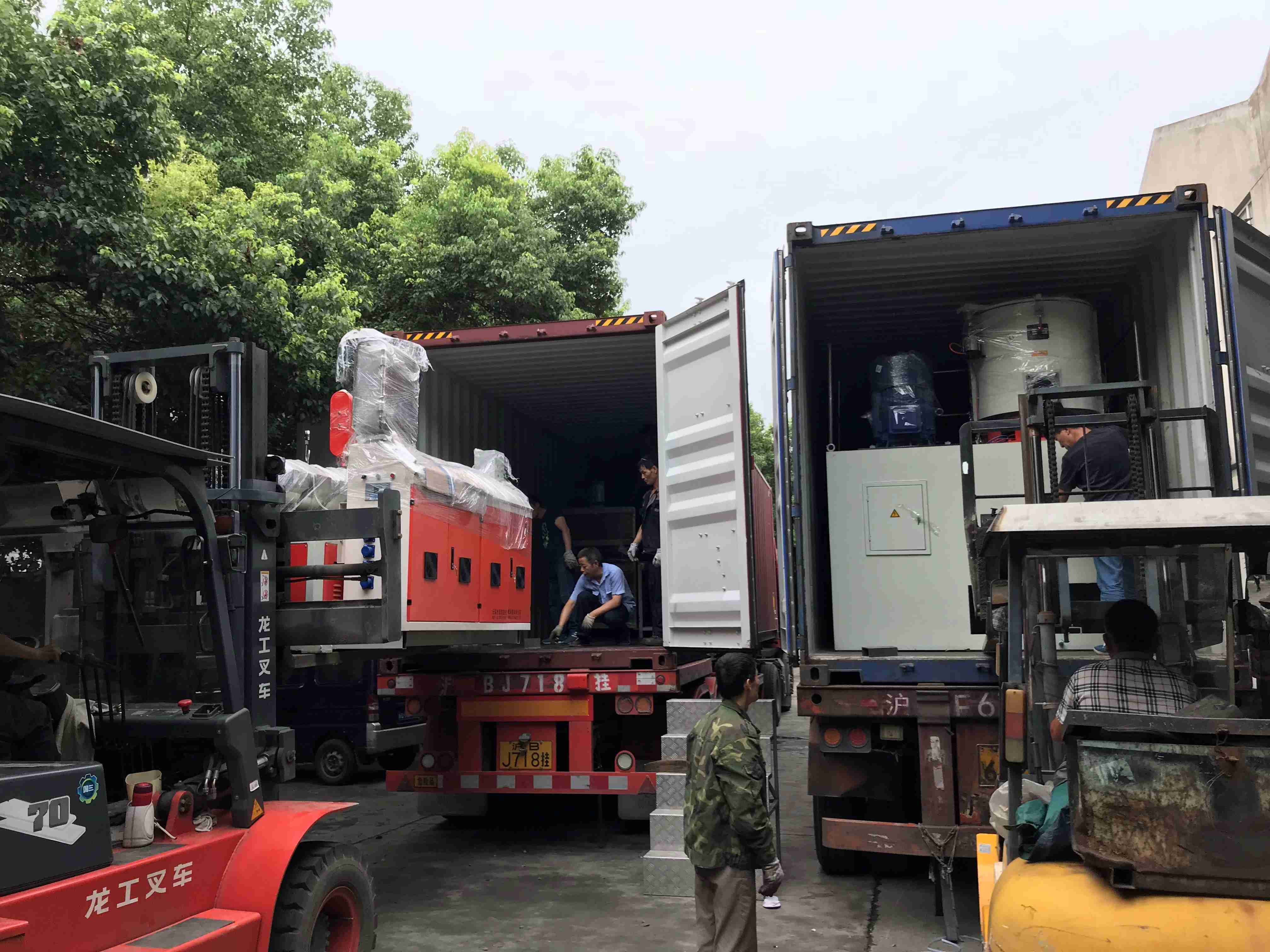
Container loading for a turnkey PVC line project in Vietnam, delivered with full export documentation and on-site installation support.
Conclusion: Define the Pipe, Then the Line
Water supply, drainage and cable protection projects fail at the selection stage in predictable ways: a diameter band that is too narrow, a material that does not match the extruder architecture, an undersized downstream, or an electrical plan that ignores installed capacity. Working through the five families in order — HDPE for municipal water, gas and irrigation; PVC for building water supply and drainage; MPP and PE for buried high-voltage cable protection; corrugated for wire threading and construction drainage; steel wire mesh reinforced composite for pressurized urban water and chemical lines — resolves most of that risk before the purchase order exists. The remaining work is spec-level: confirm the model against the diameter range, confirm the power against the plant, and confirm the compliance file against the destination market.
Next Step: Match a Line to Your Pipe Specification
Wuxi JKS Machinery Manufacturing Co., Ltd. builds custom full-set plastic extrusion production lines from its 2,000 m² facility in Wuxi, Jiangsu, China, with an annual output of 200 units and exports to more than 35 countries. Share your pipe diameter range, raw material and target output, and the team will confirm the line model, downstream configuration, lead time and compliance documentation.
Email: gordon@jksjx.com | Tel: 86 18651004566 | WhatsApp: 86 18601577228
Website: www.extrudetec.com | Address: No. 81 Xixian Road, Fangqian Town, Wuxi City, Jiangsu Province, 214000, P.R. China
Download the company brochure for the full product and project reference set: JKS Machinery brochure (PDF).
Sample showroom at the JKS Machinery facility — send your pipe specification to match a line model, downstream configuration and quotation.
Have Questions or Need More Details?
Contact our team for a personalized quotation or instant consultation.
Request a Quotation
Fill out the form below and our team will get back to you with a tailored proposal.
WhatsApp Direct Chat
Prefer to chat in real-time? Message us on WhatsApp for instant assistance & quick answers.
- Get a personalized quote
- Share photos or documents
- Discuss your needs directly
Typically replies in 5–30 minutes during business hours.