
Which Plastic Extrusion Machine Fits Your Project? A Line Matching Guide for Flooring, Pipe, and Profile Plants
Which Plastic Extrusion Machine Fits Your Project? A Line Matching Guide
Choosing a plastic extrusion machine starts with the product you plan to make, not with the machine model. Flooring, pipe, profile, rod, and recycling lines require different extruder configurations, downstream equipment, and capacity planning. This guide explains how to match a plastic extrusion production line to a real project.
Plastic extrusion is a continuous process in which thermoplastic raw material is melted, plasticized, and pushed through a die to create a fixed cross-section profile. The same basic principle applies to SPC flooring sheets, PVC pipes, WPC door panels, PP construction formwork, and solid plastic rods. However, the choice of extruder type, screw size, downstream calibration, cooling, haul-off, and cutting equipment changes significantly by product. This article is written for project owners, plant investors, and procurement teams who are in the research-to-evaluation stage and need a practical framework for matching equipment to production goals.
Why Project Matching Matters More Than Brand or Price
A plastic extrusion machine is not a single generic device. It is the core of a production line that must be configured around raw material, product dimensions, output targets, and operating conditions. When the line is properly matched, the plant can run continuously with stable quality. When it is mismatched, even a well-built machine can produce poor surface finish, unstable dimensions, or unplanned downtime.
For example, SPC flooring production requires high-output twin-screw extrusion with calender rollers and precise thickness control, while PVC window profile production requires a conical twin-screw extruder with vacuum calibration and multi-chamber cooling. Both are plastic extrusion applications, but they use different machine configurations and different downstream equipment. A supplier that builds custom plastic extrusion machinery can adjust the extruder model, screw configuration, line layout, voltage, frequency, and control system to fit the project.
Wuxi JKS Machinery Manufacturing Co. Ltd. (JKS), founded in 2013, is a Chinese manufacturer that specializes in custom full-set plastic extrusion production lines and turnkey solutions. Its product range covers SPC flooring sheets, PVC/PP/WPC boards, PVC and HDPE pipes, WPC/PVC profiles, solid plastic rods, waste plastic pelletizing lines, and supporting auxiliary equipment. JKS operates from a 2,000 m² workshop with an independent R&D team of six engineers and an annual output of about 200 units. The company exports to more than 35 countries, mainly in Southeast Asia, Russia, the Middle East, Europe, Central Asia, Africa, and South America.
Understanding the Key Product Families and Their Machine Types
Sheet and Flooring Extrusion Lines
This family includes SPC flooring, PVC imitation marble sheet, PVC/WPC foam board, and PP hollow construction formwork lines. These applications share the need for wide sheet calibration, calender rollers, and thickness control, but they differ in raw material and formula.
SPC (Stone Plastic Composite) flooring lines are built around a PVC + CaCO₃ compound formula. Products range from 1 to 10 mm thickness with effective widths of 980 mm or 1250 mm. Output depends on the extruder model and typically ranges from 15 to 40 tons per 24 hours. SPC lines can be configured with optional EIR in-line synchronous wood grain embossing and with vertical or inclined four-roller calender units.
PVC imitation marble sheet lines use a PVC + CaCO₃ compound, produce sheet thickness of 1 to 12 mm, and have an effective width of 1220 mm. Output is typically 400 to 700 kg/h depending on the extruder model. These lines are used for wall panels and decorative sheets in hotels, KTV spaces, and villa interiors.
PVC and WPC foam board lines also produce 1220 mm finished width, with output of 400 to 500 kg/h depending on the extruder model. They serve kitchen cabinet boards, furniture panels, bathroom panels, construction templates, and advertising billboard substrates.
PP hollow construction formwork lines are designed for recycled PP granule with MFI below 3. The finished product is a 1220 mm wide, 15 to 20 mm thick hollow panel with an ABA three-layer structure. The SJ-130×33 (160 kW) extruder produces 500 to 600 kg/h; the SJ-90×33 (75 kW) produces 180 to 250 kg/h. A 24-hour shift typically produces 420 to 480 panels. The complete line dimension is about 34 m × 7 m × 4.5 m, and a 315 KVA transformer is recommended for 380V/50Hz three-phase power. Double-sided UV anti-aging coating is optional, and channel smoothness is 0.015 to 0.03 μm.
Pipe Extrusion Lines
Pipe lines cover PVC water supply and drainage, HDPE water pipe, PPR hot and cold water pipe, steel wire mesh reinforced composite pipe, MPP/PE high-voltage power conduit, and corrugated conduit. Each has its own downstream line configuration.
PVC water supply and drainage lines use conical twin-screw extruders. For example, the PVC63 double-station line makes Φ16 to Φ63 mm pipe with an SJSZ65/132 extruder, 37 kW main motor, 270 kg/h output, and 4 to 49 m/min hauling speed. The PVC250 line makes Φ90 to Φ250 mm pipe with SJSZ80/156, 55 kW, and 450 kg/h. The PVC630 line makes Φ315 to Φ630 mm pipe with SJSZ92/188, 110 kW, and 800 kg/h. These lines include vacuum calibration, multi-claw traction, and dust-free cutting.
HDPE water pipe lines are sized by pipe diameter range. PE110 covers Φ20 to 110 mm with a GS60/38 extruder and 150 to 400 kg/h output. PE315 covers Φ110 to 315 mm with 200 to 600 kg/h. PE630 covers Φ315 to 630 mm with 600 to 1000 kg/h. PE1000 covers Φ630 to 1000 mm with 600 to 1000 kg/h. PE1600 covers Φ1000 to 1600 mm with 600 to 1500 kg/h.
PPR pipe lines include PPR20-75 with a GS65/33 extruder (37 kW, 80 to 160 kg/h) and PPR20-110 with a GS90/30 extruder (75 kW, 80 to 250 kg/h).
Steel wire mesh reinforced composite pipe lines are divided into GS/PE-160-H through GS/PE-630-H. The first line covers Φ50 to 160 mm with 480 kW installed capacity and 312 kW actual power consumption. The largest line covers Φ315 to 630 mm with 800 kW installed capacity and 559 kW actual power consumption. These are high-capacity lines for urban pressurized water supply, chemical anti-corrosion pipelines, and underground engineering.
MPP and PE high-voltage power pipe lines are available as PEG63 (Φ20 to Φ63 mm, 70 kW installed) and PG160 (Φ75 to Φ160 mm, 125 kW installed). They are used for buried high-voltage power grid construction and underground cable protection.
Corrugated pipe lines include models such as KSPG-63, KSPG-32, KSPG-20, KS-160, and KS-75. They produce single-wall corrugated pipes from PE, PP, or PVC for cable threading, automobile wiring sleeves, and construction drainage. The smallest line makes Φ6 to Φ10 mm pipe at up to 20 m/min; the largest makes Φ90 to Φ160 mm pipe at up to 5 m/min.
Profile, Rod, and Decorative Lines
This group includes PVC/WPC door and window profiles, WPC door panels, PVC hollow wall and ceiling panels, PVC grille and decoration profiles, multi-material profiles, and solid plastic rods. These lines tend to require precise dimensional control and specific mold designs.
PVC hollow wall panel and ceiling lines use SJSZ51, SJSZ55, SJSZ65, or SJSZ80 extruders. Output ranges from 120 kg/h at 300 mm width to 400 kg/h at 1200 mm width. End products include wall panels, ceiling boards, door panels, and furniture cabinet panels.
WPC door panel lines use SJSZ80 (75 kW, 250 to 400 kg/h) or SJSZ92 (110 kW, 400 to 600 kg/h) with PVC + CaCO₃ compounds. The panels serve interior doors, hotel and office furniture, and home decoration.
PVC grille and decoration profile lines use SJSZ51, SJSZ55, or SJSZ65 to make window and door profiles, skirting lines, decorative moldings, and WPC deck tiles. Product width goes from 100 mm to 300 mm, with output from 120 kg/h to 250 kg/h.
Multi-material profile lines use SJ45, SJ50, or SJ65 single-screw extruders to process PP, PE, PVC, PS, PC, and ABS. With custom molds they can produce imitation marble profiles, ceiling panels, door and window small profiles, sealing strips, edge bands, PC lamp profiles, and PVC waterstops.
Solid plastic rod lines are built around SJ45 or SJ65 single-screw extruders. The SJ45 produces rods of Φ6 to 60 mm with 5 to 18 kg/h output. The SJ65 produces Φ30 to 200 mm rods with 20 to 60 kg/h. Materials include PP, PE, PA, and POM. Full lines include feeding dryer, extruder, sizing mold, cooling tank, caterpillar haul-off, and fixed-length cutting and stacking. These rods are used for mechanical spare parts, gears, bushings, and insulation bars.
Recycling, Pelletizing, and Auxiliary Equipment
Recycling and pelletizing lines are often needed by pipe and profile plants to reuse internal scrap. JKS offers crushers, pulverizers, PVC hot-cut pelletizing lines, and mixing and cooling units.
The SP400 and SP660 crushers process PVC, PE, and PP scraps. The SP400 runs at 15 kW and crushes 300 to 400 kg/h. The SP660 runs at 22 kW and crushes 600 to 700 kg/h. They are used in recycling plants and PVC compounding lines.
The MF400, MF500, and MF600 pulverizers convert PVC, PE, and PP scraps into 40 to 80 mesh powder. Output ranges from 200 kg/h (MF400) to 400 to 500 kg/h (MF600).
PVC hot-cut pelletizing lines use SJSZ55, SJSZ65, SJSZ80, or SJSZ92 conical twin-screw extruders. Output ranges from 100 to 150 kg/h on the SJSZ55 to 650 to 800 kg/h on the SJSZ92. They perform hot die-face cutting with cooling and grading systems.
PVC mixing and cooling units are available in SRL-Z200/500, SRL-Z300/600, SRL-Z500/1000, and SRL-Z1000/3000. Mixing time is 8 to 10 minutes per pot; cooling time is 6 to 8 minutes per pot. Throughput ranges from 300 to 400 kg/h up to 1600 to 2000 kg/h. These units are used in PVC pipe, profile, sheet, and pelletizing lines.
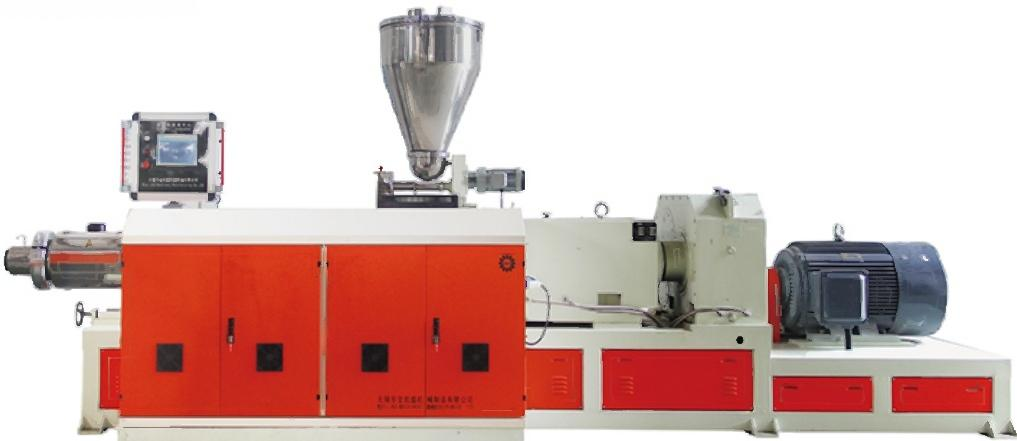
JKS SJSZ conical twin-screw PVC extruder: one machine family serves pipe, profile, sheet, and pelletizing lines.
Step-by-Step: How to Match a Plastic Extrusion Machine to Your Project
- Define the final product and material formula. Determine whether your project makes SPC flooring, PVC pipe, WPC door panel, PP formwork, plastic rod, or recycled pellets. Confirm the raw material and possible high-fill PVC formulation. The material determines whether you need a conical twin-screw extruder for direct PVC powder processing or a single-screw extruder for general thermoplastics.
- Set the product dimensions and output target. Choose sheet width, thickness, pipe diameter range, profile width, or rod diameter. Match output capacity in kg/h or tons per 24 hours.
- Select the extruder family and model. For direct PVC powder extrusion, conical twin-screw models such as SJSZ-45 through SJSZ-110 provide output from 70 kg/h to 1000 kg/h. For PP, PE, PA, POM, ABS, and other thermoplastics, single-screw models such as the SJ series are used.
- Match downstream equipment. Pipe projects need vacuum calibration, cooling tanks, multi-claw traction, and cutting systems. Sheet projects need calender rollers and haul-off units. Profile projects need calibration tables and fixed-length cutting. Rod projects need sizing molds and caterpillar haul-off.
- Check plant conditions and power supply. Large lines such as the PP formwork line have a machine footprint of about 34 m × 7 m × 4.5 m and may require a 315 KVA transformer. Confirm voltage and frequency with the supplier.
- Plan for scrap recycling. Add a crusher, pulverizer, or pelletizing line if the plant will generate internal scrap from pipe, profile, or sheet production.
- Confirm customization and service scope. JKS offers OEM, ODM, and custom design services with adjustments to extruder model, screw configuration, production line layout, voltage and frequency, control system, and capacity. Monthly capacity is about 30 units, typical lead time is 40 work days, and MOQ is one unit.
Decision Framework: Which Line Should You Choose?
| Project Type | Recommended Line | Key Extruder Example | Typical Output | Typical Product Width / Pipe Range |
|---|---|---|---|---|
| SPC flooring plant | EIR In-line SPC flooring extrusion line | SJSZ92/188 or SJSZ110/220 | 15–40 tons/24h | 980 mm / 1250 mm; 1–10 mm thickness |
| Decorative wall sheet plant | PVC imitation marble sheet line | SJSZ80/156 or SJSZ92/188 | 400–700 kg/h | 1220 mm; 1–12 mm thickness |
| Furniture / foam board plant | PVC & WPC foam board line | SJSZ80/156 or 80+165 co-extrusion | 400–500 kg/h | 1220 mm |
| Construction formwork plant | PP hollow construction formwork line | SJ-130×33 or SJ-90×33 | 500–600 kg/h or 180–250 kg/h | 1220 mm; 15–20 mm thickness |
| PVC water pipe plant | PVC water supply & drainage line | SJSZ65/132, SJSZ80/156, or SJSZ92/188 | 270–800 kg/h | Φ16–Φ630 mm |
| HDPE water pipe plant | HDPE solid-wall pipe line | GS60/38 to GS150/38 | 150–1500 kg/h | Φ20–Φ1600 mm |
| High-pressure composite pipe plant | Steel wire mesh reinforced composite pipe line | GS/PE-160-H to GS/PE-630-H | Actual power 312–559 kW | Φ50–Φ630 mm |
| Buried cable protection | MPP & PE high-voltage power pipe line | PEG63 or PG160 | 70–125 kW installed | Φ20–Φ160 mm |
| Door panel / interior door plant | WPC door panel line | SJSZ80 or SJSZ92 | 250–600 kg/h | Door slabs and door frame profiles |
| Wall / ceiling panel plant | PVC hollow wall panel & ceiling line | SJSZ51–SJSZ80 | 120–400 kg/h | 300–1200 mm width |
| Profile manufacturer | PVC grille & decoration profile line | SJSZ51, SJSZ55, or SJSZ65 | 120–250 kg/h | 100–300 mm product width |
| Engineering plastic rod | Solid plastic rod line | SJ45 or SJ65 | 5–60 kg/h | Φ6–Φ200 mm |
| PVC compounding / scrap recycling | PVC hot-cut pelletizing line | SJSZ55–SJSZ92 | 100–800 kg/h | Uniform pellets |
Real Project Evidence: Flooring and Wall Panel Lines
SPC Flooring Line in Malaysia
A Malaysian SPC flooring manufacturer installed one complete SPC flooring extrusion line from JKS for residential and commercial flooring production. The line has been in stable operation for more than 10 years. The stated results include stable continuous production, consistent product quality, and a low maintenance rate. On-site installation and training support were part of the project.
SPC Flooring Line in South Korea
A South Korean flooring manufacturer operates one complete SPC flooring extrusion line from JKS, producing SPC flooring sheets for residential and commercial use. The line has been running for more than 8 years. The manufacturer reports stable 24/7 production, consistent product quality, and a low maintenance rate. High output and precise thickness control are cited as key benefits.
PVC Hollow Wall Panel Line in Vietnam
A Vietnamese plastic building materials manufacturer operates one complete PVC hollow wall panel extrusion line from JKS for construction and interior decoration. The line has been in stable operation for more than 5 years. The project was delivered as a complete turnkey solution with on-site installation support and full export documentation.
These cases share a common pattern: the line was matched to a specific product type and output requirement, and the supplier provided installation and training support to keep the line running continuously.
Customization, Quality Control, and After-Sales Support
Custom plastic extrusion lines are not purely off-the-shelf products. JKS offers OEM, ODM, and custom design services. Customization can cover extruder model, screw configuration, production line layout, voltage and frequency, control system, and capacity adjustment. Monthly production capacity is about 30 units, with a typical lead time of 40 work days and a minimum order quantity of one unit.
Quality control is handled through 100% factory pre-assembly and testing before shipment. Third-party inspection is available on request. After-sales service includes overseas installation guidance, on-site commissioning, operator training, remote technical support, and a 12-month warranty.
For project planning, buyers should share the raw material formula, finished product specifications, target output, available workshop space, and power supply conditions with the supplier. This information determines the extruder model, screw design, downstream configuration, and auxiliary equipment list.
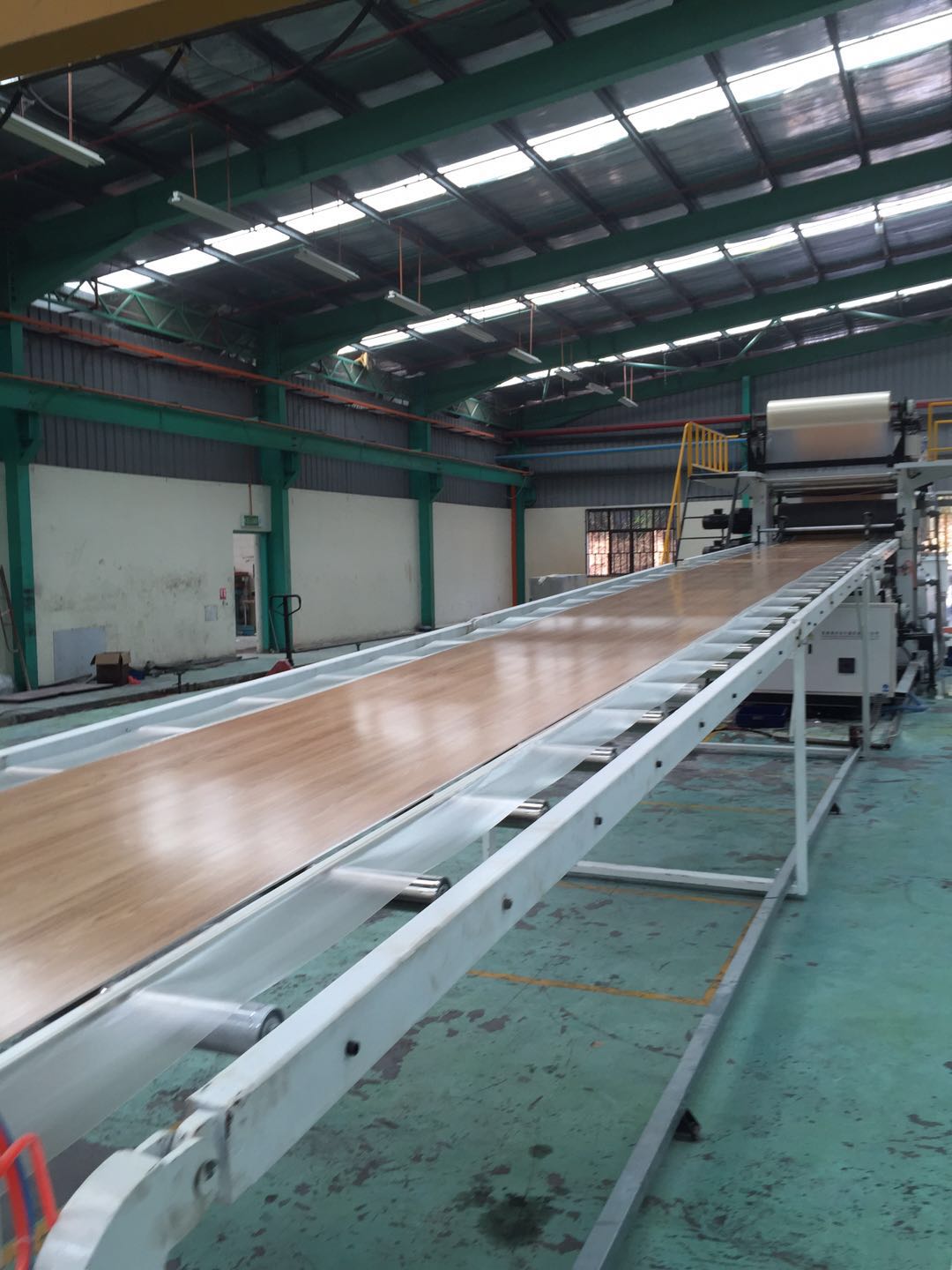
SPC flooring extrusion line in continuous operation at a customer site in Malaysia.
Market Context and Why This Matters for Buyers
The global plastic extrusion machinery market was valued at approximately USD 8.93 billion in 2024 and is projected to reach USD 11.58 billion by 2030, according to Grand View Research. The global pipe extrusion lines market is valued at USD 4.8 billion in 2025, with PVC as the leading material segment at 38.6% of the market, according to Dataintelo. The Stone Plastic Composite flooring market is projected to grow from USD 6.4 billion in 2026 to USD 10.3 billion by 2033, driven by a 7.2% CAGR, according to Grand View Research.
Asia Pacific dominated the extrusion machinery market in 2024 with a 41.5% revenue share, with China as the leading contributor in the region. Single-screw extrusion machines held a dominant share of approximately 62.7% in the global extrusion machinery market in 2024. These trends indicate continued demand for plastic sheet, pipe, and flooring production capacity in fast-growing construction and infrastructure markets.
For buyers, the practical implication is that demand growth is strongest in PVC-based products and SPC flooring. A custom line that can produce these high-demand products with stable output is more likely to deliver a return on investment than a general-purpose line that does not match the project's product mix.
Limitations and Trade-offs to Consider
No single plastic extrusion line can cover all product families at optimal efficiency. A sheet line with calender rollers cannot easily be converted to a pipe line, and a high-output twin-screw line may not be economical for short production runs. Buyers should evaluate the trade-off between flexibility and output efficiency.
Conical twin-screw extruders are particularly suitable for direct PVC powder extrusion, including high-filled PVC formulations. They provide good plasticization, high output, and stable quality. For general thermoplastics such as PP, PE, PA, POM, and ABS, single-screw extruders are more commonly used. The correct choice depends on the material, not on the brand.
Large lines require more floor space and higher installed power. The PP hollow formwork line, for example, is about 34 m × 7 m × 4.5 m and may require a 315 KVA transformer. Before ordering, confirm workshop space, power supply, and local voltage and frequency with the supplier.
FAQ: Plastic Extrusion Machine Project Matching
What compliance or standards should I confirm before buying a plastic extrusion machine?
Buyers planning to sell into the EU should confirm whether the equipment meets CE requirements. Many buyers also require ISO 9001 quality management certification from the manufacturer. JKS supports third-party inspection on request and provides full export documentation for overseas projects. Ask the supplier to state which standards apply to electrical components, safety guards, and control panels before signing a contract.
How do I know if a supplier can handle a complete turnkey line?
Check whether the supplier can deliver the full line, not just the extruder. For example, JKS supplies complete lines that include downstream equipment such as vacuum calibration, cooling tanks, haul-off machines, cutting units, and stacking systems. The company states that it performs 100% factory pre-assembly and testing before shipment and provides overseas installation guidance, on-site commissioning, and operator training. Ask for the specific line configuration and commissioning plan for your product.
What capacity should I choose for a new SPC flooring or pipe project?
Capacity should match your sales plan and raw material supply. SPC flooring lines from JKS produce 15 to 40 tons per 24 hours depending on the extruder model. PVC water pipe lines produce 270 to 800 kg/h depending on line model. HDPE pipe lines produce 150 to 1500 kg/h depending on the extruder model. A supplier can recommend an extruder model based on your target output and product dimensions.
Can you provide a sample or reference project for a specific line?
JKS has supplied SPC flooring lines to manufacturers in Malaysia and South Korea, with the lines still in stable operation after 10 and 8 years respectively. A PVC hollow wall panel line supplied to Vietnam has run for more than 5 years. For project-specific references, contact JKS with your target product and country so they can share relevant case evidence and a line layout.
What is the typical lead time and what does the supplier need from me?
JKS states a typical lead time of 40 work days and a minimum order quantity of one unit. To start, the supplier needs raw material details, finished product specifications, target output, workshop dimensions, and power supply conditions. If you are still evaluating options, JKS can provide a brochure and discuss a custom line configuration before you commit.
Conclusion
The right plastic extrusion machine for a project is the one that matches the product, material, output target, and plant conditions. Buyers should start with the final product and work backward to the extruder model and downstream configuration. SPC flooring, PVC pipe, WPC door panels, PP formwork, solid rods, and recycling lines each have distinct equipment requirements.
When evaluating suppliers, look for evidence of complete turnkey capability, custom design service, factory pre-assembly, and after-sales installation support. JKS provides a practical reference point: a 2,000 m² factory, a six-engineer R&D team, about 200 units of annual output, and export to more than 35 countries across Southeast Asia, Russia, the Middle East, Europe, Central Asia, Africa, and South America.
To move from evaluation to decision, download the JKS WPC wood-plastic door project brochure for line details, or contact JKS with your raw material, product specification, and output target for a custom line recommendation.
Thinking about a custom plastic extrusion line?
Send your product specifications and output target to JKS for a project-matched equipment proposal.
Have Questions or Need More Details?
Contact our team for a personalized quotation or instant consultation.
Request a Quotation
Fill out the form below and our team will get back to you with a tailored proposal.
WhatsApp Direct Chat
Prefer to chat in real-time? Message us on WhatsApp for instant assistance & quick answers.
- Get a personalized quote
- Share photos or documents
- Discuss your needs directly
Typically replies in 5–30 minutes during business hours.