
PVC Pipe Production Stalling? Solving Dry-Blend and Extrusion Bottlenecks via Mixing & Cooling Units
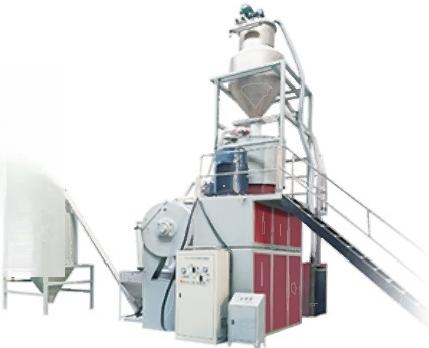
Cover: JKS SRL-Z series PVC Mixing & Cooling Unit, the dry-blend stage that sets the throughput ceiling for a PVC pipe extrusion line.
PVC Pipe Production Stalling? Solving Dry-Blend and Extrusion Bottlenecks via Mixing & Cooling Units
A PVC pipe extrusion line rarely fails in one dramatic event. It stalls gradually: hourly output drifts below the shift target, wall thickness wanders around the pipe circumference, screw torque and melt pressure become uneven, and the pipe surface starts showing fisheyes or unmelted grains. Operators usually respond by adjusting the extruder, yet the cause often sits one step upstream in the dry blend that feeds it. This article explains how to diagnose the mixing and cooling stage, then match a PVC Mixing & Cooling Unit, a Conical Twin Screw Plastic Extruder and a PVC Water Supply & Drainage Pipe Extrusion Line into one stable production unit, including the specifications, acceptance criteria and purchasing terms buyers should confirm before ordering.
Wuxi JKS Machinery Manufacturing Co., Ltd. (brand: JKS Plastic Extrusion Machine) is a manufacturer of custom plastic extrusion machinery and complete turnkey production lines, founded in 2013 and based in Wuxi, Jiangsu Province, China. The company builds full-set lines for SPC flooring sheet, PVC/PP/WPC board, PVC and HDPE pipe, WPC/PVC profile, plastic rod and waste plastic pelletizing, together with standalone single-screw and conical twin-screw extruders and auxiliary equipment such as mixers, crushers and pulverizers. Its equipment is exported to Southeast Asia, Russia, the Middle East, Europe, Central Asia, Africa and South America, with roughly 50% of output going to export markets.
Problem Definition: What "Stalling" Actually Means on a PVC Pipe Line
A stalling PVC pipe line is a line whose output, dimensional consistency or surface quality degrades within a shift even though the extruder setpoints have not changed. The symptom becomes visible at the extruder, but the trigger is normally a dry blend that is either not uniformly mixed, not cooled fast enough, or not fed into the extruder at a constant rate.
Typical reported symptoms in pipe and profile plants include:
- Hourly output falling below the nameplate rate on the second or third shift.
- Fluctuating screw torque and melt pressure, with visible surging at the die.
- Fisheyes, unmelted grains or gelation lines on the pipe surface.
- Wall thickness drift and eccentricity that increases across a production run.
- Bridging and rat-holing of compound in the hopper or storage silo.
- Agglomerated lumps appearing after the compound has cooled and settled.
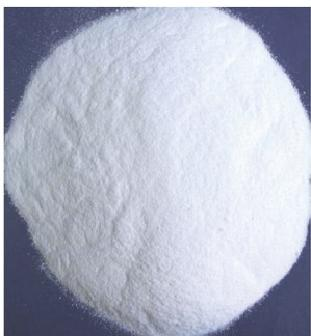
Dry blend is the first process variable on the line: mix uniformity and cooling behaviour decide what the extruder receives.
The table below is a diagnostic map, not a parts list: it points to the stage that should be checked first when a specific symptom appears.
| Symptom on the line | Stage to check first |
|---|---|
| Output drops, torque becomes uneven | Dry-blend uniformity (mixing stage), then plasticizing behaviour in the extruder |
| Lumps or agglomerated compound after storage | Cooling stage of the mixing and cooling unit |
| Fisheyes, gel lines, unmelted grains | Mixing consistency plus uniform plasticizing and mixing in the extruder |
| Wall thickness drift, eccentricity | Extruder output stability, then vacuum calibration and haul-off |
| Bridging in the feeding section | Compound temperature and agglomeration before extrusion |
| Short screw and barrel service intervals | Abrasive, highly filled compound versus screw and barrel material grade |
The practical conclusion is that a pipe line should be tuned as a chain: dry blend first, extruder second, downstream calibration third. Buying a larger extruder to solve a mixing problem usually moves the bottleneck rather than removing it.
Industry Background: Why the Dry Blend Sets the Ceiling for Pipe Output
PVC pipe compounds are usually built on PVC resin plus calcium carbonate and additives, and they are processed as a dry blend rather than as pre-compounded pellets. The mixing and cooling unit therefore has a specific job: mixing PVC resin with additives such as stabilizers, plasticizers and fillers at high speed, then cooling the batch to prevent agglomeration. When the cooling step is incomplete, compound that is still warm continues to fuse in the silo or hopper, creating the lumps and feeding interruptions that show up later as surging at the die.
Demand context matters here. Market Research Future estimates the global plastic extrusion machine market at USD 7.9 billion in 2025, with a projection of USD 12.87 billion by 2035. On the supply side, the Observatory of Economic Complexity reports that China was the leading exporter of rubber and plastic working machinery under HS 8477 in 2024 with USD 8.55 billion, followed by Germany with USD 6.11 billion and Italy with USD 2.61 billion.
Two conclusions follow for buyers at the research and evaluation stage. First, machine availability is not the constraint; a pipe plant can source extrusion hardware from many markets. Second, because hardware supply is broad, the differentiator shifts to process consistency: whether the mixing stage, the extruder and the downstream pipe line are sized and supplied as one matched system, with documentation that can be verified before payment.
The Three Units That Decide Whether the Line Stalls
1. PVC Mixing & Cooling Unit (SRL-Z Series)
A PVC Mixing & Cooling Unit is the unit that prepares the dry blend: it mixes PVC resin with stabilizers, plasticizers and fillers at high speed, then cools the batch to prevent agglomeration before the material reaches the extruder. It is used on PVC pipe, profile, sheet and pelletizing production lines, and its normal working condition is an indoor factory with elevated temperature and continuous operation. The stated selection requirements for this stage are uniform mixing, precise temperature control and easy cleaning, and it is normally operated with conveyors, storage silos and the extruder that follows it.
| Model | Rated power | Capacity | Cycle time | Construction |
|---|---|---|---|---|
| SRL-Z200/500 | 37 / 7.5 kW | 300-400 kg/h | Mixing 8-10 min/pot; cooling 6-8 min/pot | Mixing pot: stainless steel; frame: carbon steel |
| SRL-Z300/600 | 55 / 11 kW | 450-600 kg/h | Mixing 8-10 min/pot; cooling 6-8 min/pot | Mixing pot: stainless steel; frame: carbon steel |
| SRL-Z500/1000 | 75 / 15 kW | 800-1000 kg/h | Mixing 8-10 min/pot; cooling 6-8 min/pot | Mixing pot: stainless steel; frame: carbon steel |
| SRL-Z1000/3000 | 160 / 22 kW | 1600-2000 kg/h | Mixing 8-10 min/pot; cooling 6-8 min/pot | Mixing pot: stainless steel; frame: carbon steel |
For a buyer, the important boundary condition is the capacity step between models. A plant that upgrades from a 300-400 kg/h dry blend to an 800-1000 kg/h dry blend is not simply buying a bigger pot; it is changing how much buffer the line has against the 8-10 minute mixing and 6-8 minute cooling cycle, and how much compound must be stored between the mixer and the extruder hopper.
2. Conical Twin Screw Plastic Extruder (SJSZ Series)
A Conical Twin Screw Plastic Extruder is the unit that converts the dry blend into melt. Its documented characteristics are uniform plasticizing and mixing, low shearing, high productivity, stable quality and long service life, and its primary application is direct extrusion of PVC powder for pipes, sheets, bars and profiles. The screw and barrel are made of 38CrMoAlA nitrided alloy steel, and the machine frame is Q235 carbon steel.
| Model | Power | Output |
|---|---|---|
| SJSZ-45 | 15 kW | 70 kg/h |
| SJSZ-51 | 18.5 kW | 120 kg/h |
| SJSZ-55 | 22 kW | 150 kg/h |
| SJSZ-65 | 37 kW | 250 kg/h |
| SJSZ-80 | 55 kW | 400 kg/h |
| SJSZ-92 | 90 kW | 500-600 kg/h |
| SJSZ-110 | 200 kW | 1000 kg/h |
Low shearing behaviour is relevant for PVC because the compound is heat-sensitive and highly filled; the extruder is expected to plasticize and mix uniformly without generating the shear spikes that produce gel lines and surface defects. In practice, SJSZ models are used on PVC pipe, profile, sheet and pellet lines, and on WPC door and flooring lines.
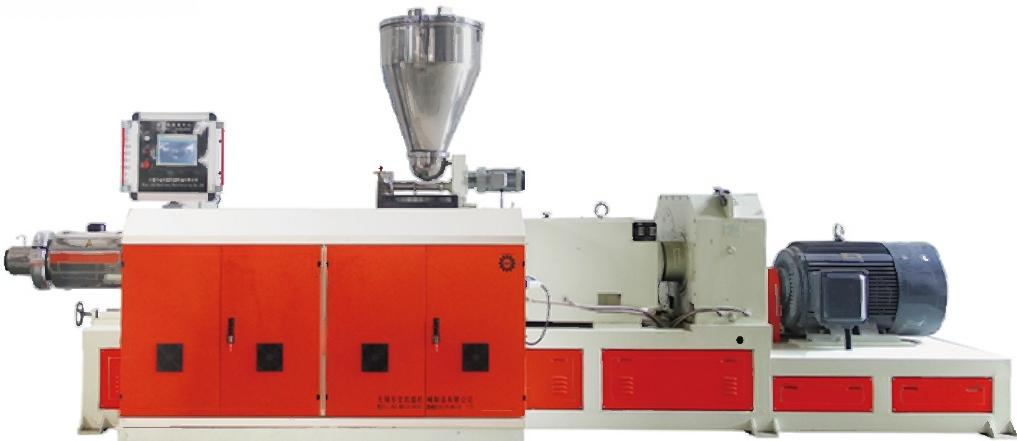
JKS SJSZ conical twin screw PVC extruder: screw and barrel in 38CrMoAlA nitrided alloy steel, frame in Q235 carbon steel.
3. PVC Water Supply & Drainage Pipe Extrusion Line
The PVC Water Supply & Drainage Pipe Extrusion Line is the downstream system that turns melt into saleable pipe. JKS builds it in three models, each matched to a conical twin screw extruder, running PVC plus calcium carbonate compound and equipped with vacuum calibration, multi-claw traction and a dust-free cutting unit. The extrusion mould is made of precision casting die steel, the screw and barrel use 38CrMoAlA nitrided alloy steel, and the machine frame is Q235 carbon steel. Typical applications are building water supply and drainage, agricultural irrigation and cable threading pipe.
| Line model | Pipe range | Matching extruder | Main motor | Downstream power | Hauling speed | Output |
|---|---|---|---|---|---|---|
| PVC63 (double station) | Φ16-Φ63 mm | SJSZ65/132 | AC 37 kW | 24 kW | 4-49 m/min | 270 kg/h |
| PVC250 | Φ90-Φ250 mm | SJSZ80/156 | AC 55 kW | 24 kW | 4-15 m/min | 450 kg/h |
| PVC630 | Φ315-Φ630 mm | SJSZ92/188 | AC 110 kW | 39 kW | 0-5 m/min | 800 kg/h |
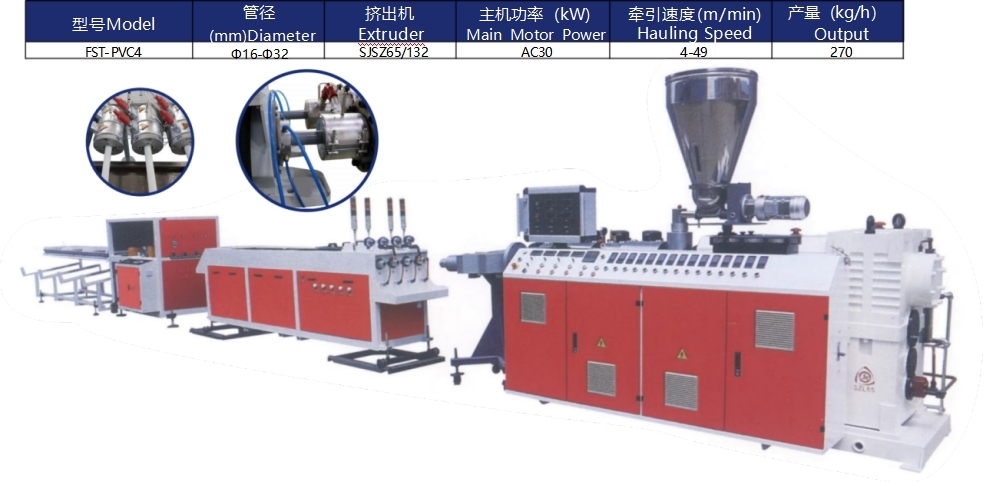
PVC water supply & drainage pipe extrusion line: vacuum calibration, multi-claw traction and dust-free cutting, with a precision casting die steel mould.
Step-by-Step: Matching Mixing, Extrusion and Pipe Output
Matching a line is a sequence of constraints, not a single decision. The steps below follow the order in which the constraints actually bind.
- Fix the pipe specification first. Diameter range determines which line model applies: PVC63 covers Φ16-Φ63 mm, PVC250 covers Φ90-Φ250 mm and PVC630 covers Φ315-Φ630 mm. Pipe range cannot be expanded by changing the extruder alone, because the calibration, haul-off and cutting units are sized to match.
- Read the required output from the line model. The three pipe lines are stated at 270 kg/h, 450 kg/h and 800 kg/h respectively. This number is the anchor for every downstream decision, including the mixing stage.
- Confirm the extruder that the line is matched with. PVC63 runs with SJSZ65/132 at AC 37 kW, PVC250 with SJSZ80/156 at AC 55 kW, and PVC630 with SJSZ92/188 at AC 110 kW. If a buyer intends to run a wider diameter range later, the extruder model is the first item to revisit, not the calibration table.
- Size the mixing and cooling unit against the extruder, not against the catalogue. The rule applied here is that the rated capacity of the mixing and cooling unit should be at least equal to the hourly output of the line, so that the extruder is never waiting for compound. The SRL-Z range starts at 300-400 kg/h and extends to 1600-2000 kg/h.
- Check the cycle time against the shift pattern. Mixing runs 8-10 minutes per pot and cooling 6-8 minutes per pot. A plant running a single mixer feeding a continuous pipe line has to decide how much buffer silo capacity it wants, because the extruder consumes continuously while the mixer works in batches.
- Confirm the material and cleaning boundary conditions. The mixing pot is stainless steel with a carbon steel frame, and the stated operating requirements for this stage are uniform mixing, precise temperature control and easy cleaning. Easy cleaning matters most when a plant changes formulation or colour between runs.
- Confirm the downstream scope in writing. For pipe lines, this means vacuum calibration, multi-claw traction and dust-free cutting, plus the mould specification: precision casting die steel for pipe, 38CrMoAlA nitrided alloy steel for screw and barrel, Q235 carbon steel for the frame.
- Fix the customization envelope before quotation. Documented customization scope covers the extruder model, screw configuration, production line layout, voltage and frequency, control system and capacity adjustment, under OEM, ODM and custom design production modes.
Comparison: Pipe Line, Extruder and Mixing Capacity in One View
The table below consolidates the three pipe line models with their matched extruders and the mixing and cooling unit that satisfies the capacity rule described in step 4. Only catalogue values are listed; the final column applies one transparent rule, that the rated capacity of the mixing and cooling unit must be at least equal to line output, and reads the nearest matching SRL-Z model.
| Pipe line | Pipe range | Matched extruder | Line output | Mixing & cooling unit with rated capacity ≥ line output |
|---|---|---|---|---|
| PVC63 | Φ16-Φ63 mm | SJSZ65/132 | 270 kg/h | SRL-Z200/500 (300-400 kg/h) |
| PVC250 | Φ90-Φ250 mm | SJSZ80/156 | 450 kg/h | SRL-Z300/600 (450-600 kg/h) |
| PVC630 | Φ315-Φ630 mm | SJSZ92/188 | 800 kg/h | SRL-Z500/1000 (800-1000 kg/h) |
The pattern is straightforward: as pipe diameter and hourly output rise, the extruder moves up the SJSZ range and the mixing and cooling unit moves up the SRL-Z range in step. A line that is upgraded on the extrusion side but not on the dry-blend side will stall again at the next shift.
Use Cases: Where the Dry-Blend Bottleneck Shows Up
Water supply and drainage pipe plants running PVC plus calcium carbonate. This is the core application for the three pipe line models above. Because the compound is highly filled and heat-sensitive, output stability depends more on consistent dry blend than on pushing the extruder harder.
Small-diameter, high-speed lines. The PVC63 double-station line hauls pipe at 4-49 m/min. At that speed the margin between a good run and a rejected run is small, so even short dry-blend fluctuations that would be absorbed on a large-diameter line become visible wall thickness variation on small pipe.
Plants that share one mixing stage across several products. The mixing and cooling unit is listed for PVC pipe, profile, sheet and pelletizing production lines. A plant running pipe during the day and profiles or wall panels at night is really running one dry-blend department, and the mixing cycle time and cleaning requirement then apply to the whole product mix, not to a single line.
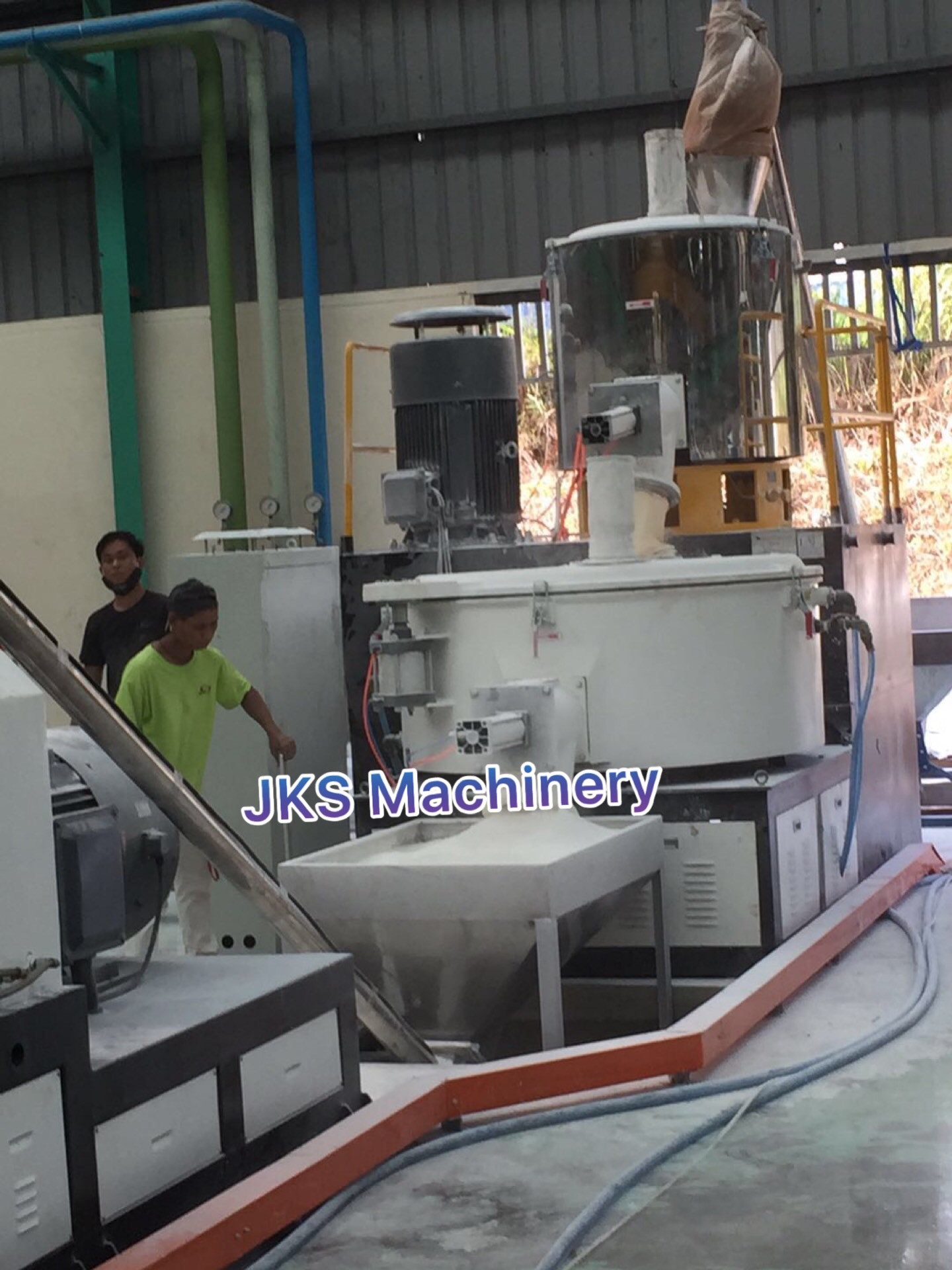
Mixing stage in operation at a customer production site: dry-blend consistency is the first checkpoint when output drifts.
Verified deployment evidence. JKS machines are running in long-cycle production at customer plants in several markets: a complete SPC flooring extrusion line in Malaysia has been in stable operation for more than 10 years with a low maintenance rate and on-site installation and training support; a comparable SPC flooring line in Korea has run over 8 years with stable 24/7 production; and a complete PVC hollow wall panel extrusion line supplied to Vietnam has been in stable operation for more than 5 years with full export documentation. These are adjacent PVC processes rather than pipe lines, but they exercise the same mixing, extrusion and downstream sequence, which makes them relevant reference points when evaluating supplier reliability.
Purchasing Terms and Acceptance Criteria Checklist
Once the technical match is fixed, the commercial and acceptance terms decide whether the delivery matches the specification. The following items should be written into the purchase documents rather than agreed verbally.
- Commercial terms: minimum order quantity 1 unit; lead time 40 work days; monthly production capacity 30 units.
- Quality control: 100% factory pre-assembly and testing before shipment, with third-party inspection available on request.
- Warranty: 12 months.
- After-sales scope: overseas installation guidance, on-site commissioning, operator training and remote technical support.
- Customization recorded in the contract: extruder model, screw configuration, production line layout, voltage and frequency, control system and capacity adjustment, under OEM, ODM or custom design production mode.
- Compliance documentation: CE certificate of conformity for machinery, certificate number M.2021.206.C.64011, issued by UDEM International Certification Auditing Training Centre, with harmonised standards including EN ISO 12100:2010, EN 1114-1:2011, EN 60204-1:2018, EN 61000-3-2:2014, EN 61000-3-3:2013, EN 61000-6-1:2007 and EN 61000-6-3:2007/A1:2011/AC:2012, covering plastic extrusion lines including the SJSZ, SJ and SJP series models.
- Acceptance test data: agree in advance which parameters are measured on the test run, which pipe diameters are produced, and what the pass criteria are.
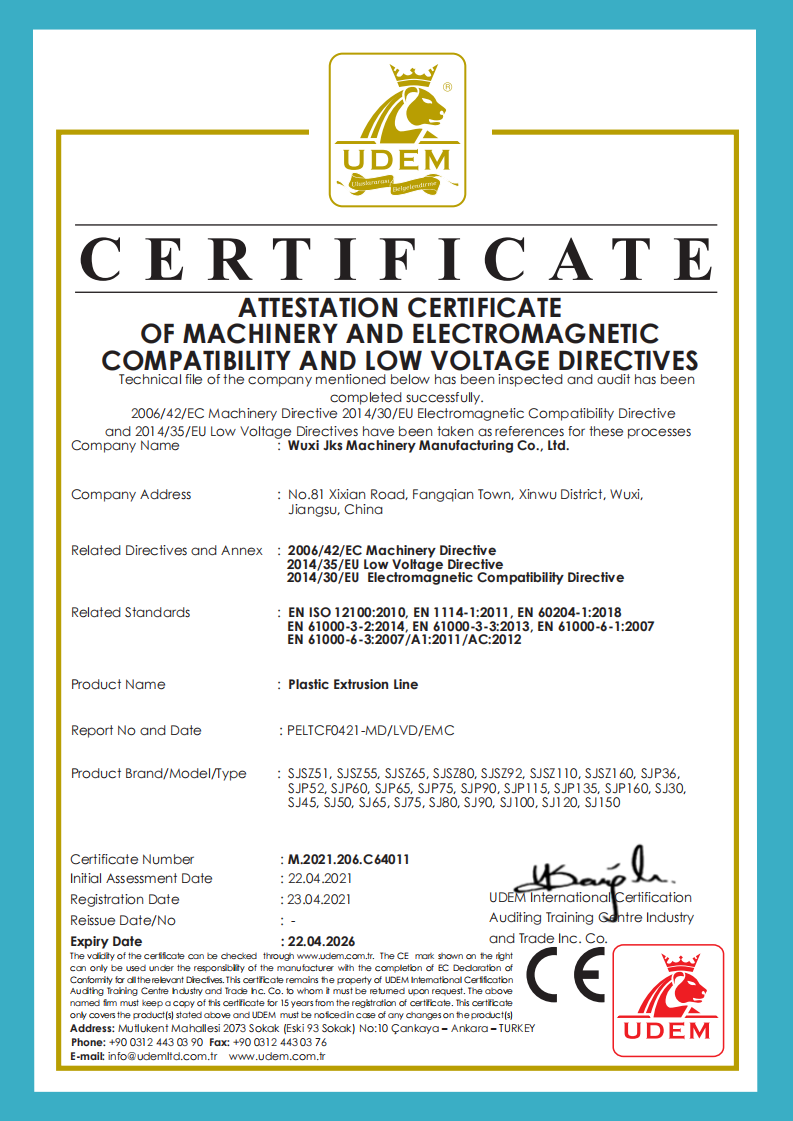
Compliance evidence: CE certificate M.2021.206.C.64011 issued by UDEM International Certification Auditing Training Centre for plastic extrusion lines.
FAQ: Dry-Blend, Extrusion and Procurement Questions
What certifications and safety standards apply to JKS mixing, extrusion and pipe line equipment?
JKS plastic extrusion lines are covered by a CE certificate of conformity for machinery under the LVD and EMC directives, certificate number M.2021.206.C.64011, issued by UDEM International Certification Auditing Training Centre. The listed harmonised standards include EN ISO 12100:2010, EN 1114-1:2011, EN 60204-1:2018, EN 61000-3-2:2014, EN 61000-3-3:2013, EN 61000-6-1:2007 and EN 61000-6-3:2007/A1:2011/AC:2012, and the certificate scope covers plastic extrusion lines including the SJSZ, SJ and SJP series models. The certificate record lists an issue date of 22 April 2021 with validity to 22 April 2026; because machinery certificates are time-limited, buyers should request the currently valid copy during supplier qualification instead of relying on a historical scan. For the United States market, ANSI/PLASTICS B151.7 applies to extrusion machines used in the plastics industry and requires a documented risk assessment process in the manufacture, care and use of the machinery, so risk-assessment documentation is a second item worth confirming.
Can the mixing and cooling unit and the extruder be matched to our own pipe formulation and diameter range?
Yes, within documented limits. The extrusion side is built around the Conical Twin Screw Plastic Extruder range SJSZ-45, 51, 55, 65, 80, 92 and 110, with outputs from 70 kg/h to 1000 kg/h and power from 15 kW to 200 kW. The dry-blend side is built around the PVC Mixing & Cooling Unit range SRL-Z200/500, SRL-Z300/600, SRL-Z500/1000 and SRL-Z1000/3000, with capacities from 300-400 kg/h to 1600-2000 kg/h and a mixing cycle of 8-10 minutes per pot plus 6-8 minutes cooling per pot. Customization scope covers the extruder model, screw configuration, production line layout, voltage and frequency, control system and capacity adjustment, under OEM, ODM and custom design production modes. Diameter capability itself is set by the pipe line model: Φ16-Φ63 mm, Φ90-Φ250 mm or Φ315-Φ630 mm.
What drives the cost of a PVC pipe dry-blend and extrusion setup?
Cost is configuration-driven rather than size-driven. The main variables are the required hourly output, which fixes the extruder model and therefore the motor rating; the pipe diameter range, which fixes the line model; the mixing and cooling unit capacity, which must at least equal line output; the electrical specification, including voltage and frequency and the control system; and the breadth of the customization package. Pipe line output steps from 270 kg/h to 450 kg/h to 800 kg/h across the three models, and each step moves the matched extruder and mixer up a size class, so the quotation should always be requested against a defined configuration rather than compared as a single headline number. Minimum order quantity is 1 unit, lead time is 40 work days, and monthly production capacity is 30 units, which are the terms that should be pinned down before commercial comparison.
Can we validate the dry blend or run a sample before ordering the full line?
Validation happens on three levels. First, formulation support: JKS provides formulation service and personalized design based on the client raw material and production demand, so the dry-blend recipe can be reviewed against the actual PVC resin, calcium carbonate and additive package. Second, factory testing: 100% factory pre-assembly and testing is carried out before shipment, and third-party inspection is available on request. Third, documentation: export documentation is provided for complete lines, as demonstrated on the PVC hollow wall panel line delivered to Vietnam. Buyers evaluating a pipe project can therefore request the compound formulation review and a factory test run as part of the quotation process rather than after the order.
What is the lead time, and what installation and after-sales support is included?
Lead time is 40 work days, with a minimum order quantity of 1 unit and a monthly production capacity of 30 units. After-sales scope includes overseas installation guidance, on-site commissioning, operator training and remote technical support, backed by a 12-month warranty; factory installation, technical training and formulation service are provided as part of the company service scope. For buyers moving from evaluation to order, the practical next step is to send the pipe diameter range, target hourly output and available power supply so the extruder, mixing and cooling unit, and downstream pipe line can be quoted as one matched configuration. The product catalogue can be downloaded here: JKS Machinery product catalogue (PDF).
Conclusion
A PVC pipe line that stalls is usually reporting a dry-blend problem through the extruder. The corrective sequence is fixed: verify mixing uniformity and cooling behaviour at the SRL-Z mixing and cooling unit, confirm that the SJSZ conical twin screw extruder is matched to the required output, and confirm that the downstream PVC water supply and drainage pipe line is matched to the pipe diameter range, with vacuum calibration, multi-claw traction and dust-free cutting included. Sizing the three stages in step, using the capacity rule that the mixer must at least equal line output, removes the most common cause of shift-to-shift output loss.
Wuxi JKS Machinery Manufacturing Co., Ltd. supplies these three stages as one coordinated system, with SJSZ-45 to SJSZ-110 extruders, SRL-Z200/500 to SRL-Z1000/3000 mixing and cooling units, and PVC pipe lines from Φ16 mm to Φ630 mm. For a line-specific configuration, send your pipe range, target output and power supply to the technical team.
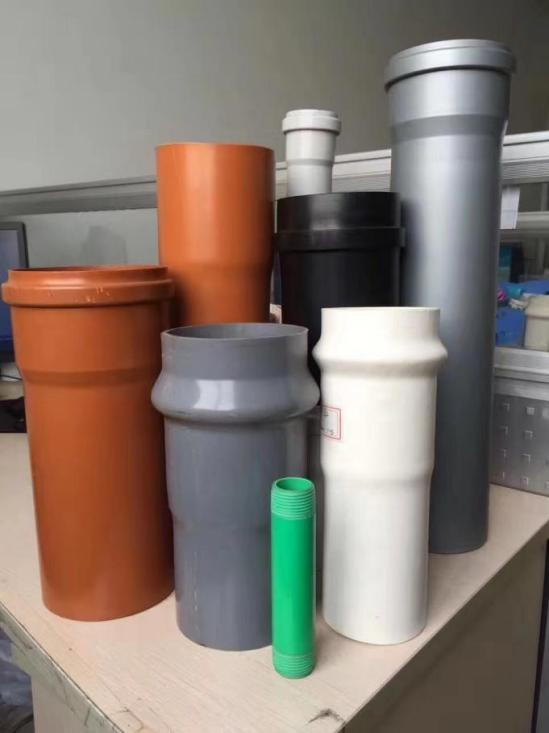
Output check: finished PVC water supply and drainage pipe, the final acceptance item on the line.
Next step: request a sample test or a line-specific quotation
Send your pipe diameter range, target hourly output and power supply specification (voltage and frequency) to JKS and receive a matched extruder plus mixing and cooling configuration.
Website: www.extrudetec.com | Blog: blog.extrudetec.com
Contact: Gordon | Email: gordon@jksjx.com | Tel: +86 18651004566 | WhatsApp: +86 18601577228
Address: No. 81 Xixian Road, Fangqian Town, Wuxi City, Jiangsu Province, 214000, P.R. China
Have Questions or Need More Details?
Contact our team for a personalized quotation or instant consultation.
Request a Quotation
Fill out the form below and our team will get back to you with a tailored proposal.
WhatsApp Direct Chat
Prefer to chat in real-time? Message us on WhatsApp for instant assistance & quick answers.
- Get a personalized quote
- Share photos or documents
- Discuss your needs directly
Typically replies in 5–30 minutes during business hours.