
Single Screw vs. Conical Twin Screw Plastic Extruder: Core Concepts for Buyers
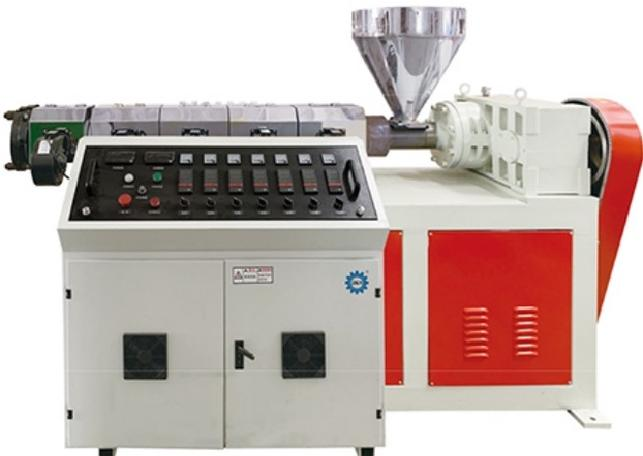
Two machines can stand side by side on the same plant floor and still belong to different families of equipment. A single screw plastic extruder conveys, melts and pumps polymer with one rotating screw inside one barrel. A conical twin screw plastic extruder uses two intermeshing, conically shaped screws that counter-rotate inside the barrel. Almost every downstream decision follows from that single structural difference: which products the line can run, which material form you are able to buy, how many auxiliary units the line needs, and how the machine will be serviced, re-tooled and supported long after commissioning.
The useful question for a buyer is therefore not 'which screw design is better'. It is 'which platform matches my material form, my product family, and the production ecosystem I am committing to'. A machine is purchased once, but a platform is lived with — screw sets, barrels, gearboxes, calibration tooling, spare-part availability and service relationships all follow the format chosen at the start.
Wuxi JKS Machinery Manufacturing Co., Ltd. (JKS Machinery) is a Chinese manufacturer of custom plastic extrusion machinery and complete turnkey production lines, based in Wuxi, Jiangsu Province. Founded in 2013, the company operates a 2,000 m² production facility with 20 employees and a 6-engineer R&D team, produces around 200 units per year, exports roughly 50% of its output, and serves markets including Southeast Asia, Russia, the Middle East, Europe, Central Asia, Africa and South America. Its scope covers standalone single screw and conical twin screw extruders as well as the auxiliary equipment around them — which is exactly why the platform question sits at the centre of this explainer.
The Buyer's Problem: Model Codes Arrive Before Concept Clarity
Most extrusion line quotations reach a buyer as a list of designations. One column carries SJ30, SJ45, SJ65 and SJ90. Another carries SJSZ-45, SJSZ-51, SJSZ-55, SJSZ-65, SJSZ-80, SJSZ-92 and SJSZ-110. Below them sit downstream units, auxiliary equipment and a price. Nothing in that list explains what the prefix means, how the screw geometry behaves, or which production jobs each platform was designed around.
Buyers then compare numbers that are not comparable. A small single screw machine and a mid-frame conical twin screw machine can sit in a similar budget band while serving completely different production roles. The letters look like a size code. In practice they describe two different ways of feeding, melting and pressurising plastic.
The cost of making this decision from a quotation rather than from concepts does not appear on the invoice. It appears in the first year of production:
- a pellet-oriented platform fed with a dry-blend formulation it was never configured for;
- auxiliary equipment that cannot keep pace with the extruder it was quoted beside;
- an output ceiling reached sooner than the sales plan required;
- wear parts with long replacement cycles and unpredictable sourcing;
- operator training repeated on a machine the production team did not plan for.
None of these are exotic failures. They all trace back to one thing: the platform was selected before the concept was understood.
Industry Background: Why Platform Decisions Carry More Weight Today
Three background signals explain why this decision deserves more attention in 2026 than a simple model comparison suggests.
First, the equipment market itself is expanding. Market Research Future's plastic extrusion machine market research estimates the global market at USD 7.901 billion in 2025 and projects it to reach USD 12.87 billion by 2035, covering both single-screw and twin-screw extruders. A growing market means more suppliers, more configurations and more quotations per project — and more room for a platform mismatch to hide inside an attractive price.
Second, supply is deeply concentrated. According to the Observatory of Economic Complexity, using UN Comtrade data for HS 8477 (rubber and plastic working machinery), China was the world's leading exporter in 2024 at USD 8.55 billion, ahead of Germany at USD 6.11 billion and Italy at USD 2.61 billion. For buyers, this means the practical differentiator is rarely 'can this supplier build an extruder'. It is whether the supplier matches the right extruder platform and line scope to a specific product plan.
Third, downstream demand is shifting toward applications where the extruder defines the whole line. Grand View Research projects the global stone plastic composite (SPC) flooring market to grow from USD 6.4 billion in 2026 to USD 10.3 billion by 2033. SPC base sheet, PVC pipe, WPC profiles and hollow boards are product families in which the screw platform drives feeding behaviour, pressure build-up and downstream tooling design. In these segments the extruder is not an interchangeable component.
Taken together, these signals point to the same conclusion: buyers are not choosing between two similar machines. They are choosing between two production logics.
Detailed Solution: The Two Core Extruder Platforms
Single Screw Plastic Extruder: The SJ Series
A single screw plastic extruder is a machine in which one screw rotates inside a cylindrical barrel, moving polymer from a feed throat through compression and metering sections to a die. JKS builds the SJ series in four stated sizes — SJ30, SJ45, SJ65 and SJ90 — designated for thermoplastics such as PVC, PP, PE, Nylon and ABS.
- Material form: it works naturally with pelletised or granulated feedstock that can be drawn into the feed section at a steady rate.
- Process logic: melting relies on barrel heating plus the mechanical shear generated by the rotating screw, so screw geometry — compression ratio, flight depth and length-to-diameter relationship — does most of the process work.
- Strengths: mechanically simple, with fewer rotating and wear components, straightforward maintenance and comparatively short operator training. Well suited to profile, pipe, rod, small sheet and pelletizing duties where the formulation arrives in a consistent pellet form.
- Boundaries: mixing and dispersive capability is more limited than a twin-screw design, and the ability to handle high filler-loading powder formulations or demanding compounding duties is constrained. When product complexity grows, buyers usually need to move up the platform ladder rather than simply enlarge the same machine.
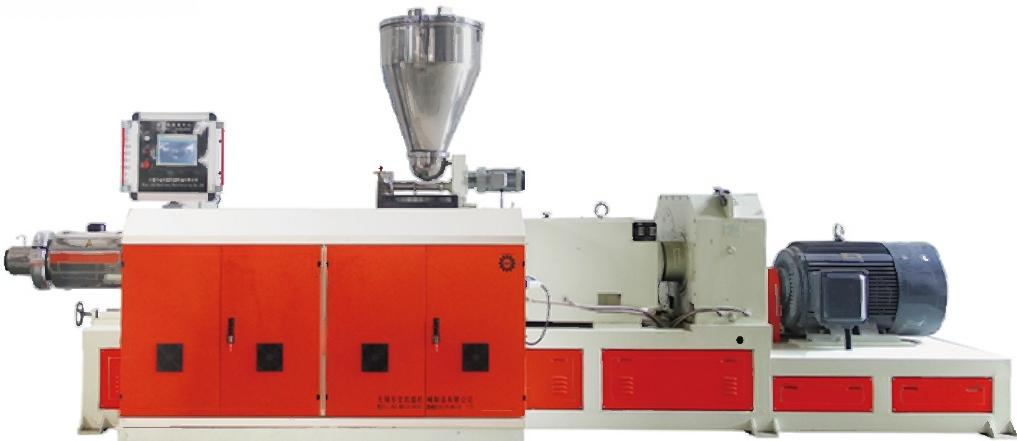
Conical Twin Screw Plastic Extruder: The SJSZ Series
A conical twin screw plastic extruder uses two intermeshing screws whose diameters taper along the barrel and which rotate in opposite directions. JKS lists the SJSZ series in seven stated sizes — SJSZ-45, SJSZ-51, SJSZ-55, SJSZ-65, SJSZ-80, SJSZ-92 and SJSZ-110.
- Material form: the design is built around powder and dry-blend feeding, where the wide end of the conical screw pair accepts and conveys material that a single screw would struggle to draw in consistently.
- Process logic: two screws work the material between them, delivering conveying, mixing and pressure generation in one unit — useful where the die and calibration equipment downstream require stable pressure and a homogeneous melt.
- Typical product families: PVC pipe, PVC and WPC profiles, hollow panels and sheets, and flooring base sheet. JKS lists production lines for PVC solid pipe, WPC door frame profiles, PVC hollow wall/ceiling/door panels and SPC flooring — all areas where conical twin-screw extrusion is the conventional platform. As one reference point at the upper end of the range, JKS lists a high-productivity SPC floor conical twin screw extruder with a stated capacity of 1,500 kg/h.
- Boundaries: more components, greater tooling and calibration complexity, and a stronger dependence on experienced maintenance than a single screw machine. It is not the default answer for every pellet-fed polyolefin job.
Shared Platform: 38CrMoAlA Nitrided Alloy Steel Screw and Barrel
Both the SJ series and the SJSZ series use 38CrMoAlA nitrided alloy steel for the screw and barrel. This detail matters far less at the quotation stage than it does in year three. Screw and barrel carry the abrasion and corrosion load, and they define the wear-replacement cycle of the machine. Nitrided alloy steel is a common engineering choice for extrusion screws and barrels because it combines surface hardness with a tough core.
Buyer reading: when two quotes differ, the difference may sit in the material and heat treatment of the parts you will eventually replace, not in the frame you can see. Confirm the screw and barrel specification — and confirm spare-part availability for that specification — before closing the commercial comparison.
Why the Platform Decision Is Really an Ecosystem Decision
The extruder is one unit in a chain. Upstream, compounding and dry-blend preparation equipment determines what arrives at the feed throat. Downstream, die, calibration, haul-off and cutting — and on sheet and flooring lines, embossing, lamination and cooling — determine whether the extruder's output becomes a saleable product. Reclaim equipment, including crushers and pelletizing lines, closes the loop on start-up scrap and rejects.
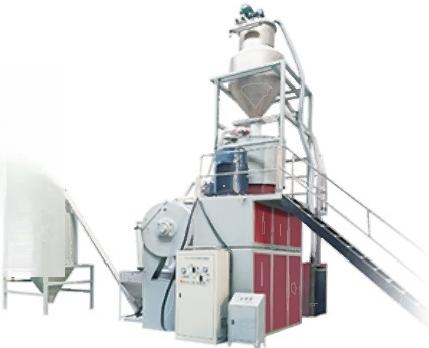
Because the extruder sets the input format (pellet or powder), the temperature and pressure profile, and the achievable output band, it effectively sets the specification of everything around it. Buying an extruder is therefore buying an entry point into a matched ecosystem of equipment, consumables and services — the long-term dimension that most quotations never show.
Step-by-Step Breakdown: Eight Decisions Before You Commit
- Define the product first, the machine second. Pipe, profile, sheet, flooring base, rod or pellets — each family narrows the platform before any model number is discussed.
- Fix the material form. Pelletised thermoplastics such as PVC, PP, PE, Nylon and ABS point toward the SJ series; dry-blend PVC-type formulations point toward conical twin-screw designs. Getting this step wrong invalidates everything that follows.
- Size the platform against a realistic output plan, not the largest number in a brochure. Larger conical twin-screw frames exist for high-volume sheet and flooring duty; matching that scale to a small profile business adds cost without adding revenue.
- Map the full ecosystem. Decide whether the line needs dry-blend mixing upstream, a crusher and pelletizing route for reclaim, and which calibration, haul-off and cutting units the product requires. JKS's stated scope covers eight production line categories, which shows how much of a line sits outside the extruder itself.
- Lock the wear-part specification. Confirm that screw and barrel materials are specified — 38CrMoAlA nitrided alloy steel in both JKS series — and ask how replacement parts are supplied after the warranty period.
- Confirm the control and safety architecture. JKS lines use PLC automatic control with real-time monitoring, overload protection and an emergency stop function, addressing the main operational risks of downtime, inconsistent product quality, material waste and electrical or mechanical failure. For U.S. market relevance, ANSI/PLASTICS B151.7 applies to extrusion machines used in the plastics industry and expects suppliers and users to apply a documented risk-assessment process. Note that public listings reference different editions — B151.7-2013 on the PLASTICS Industry Association standards page and B151.7-2014 (R2021) on the ANSI webstore — so confirm the edition applicable to your market.
- Agree the acceptance test before shipment. JKS states that quality control includes 100% factory pre-assembly and testing before shipment, with third-party inspection available on request, and pre-shipment factory test as the stated acceptance criterion.
- Agree commercial terms that fit your cash cycle. JKS states a minimum order quantity of 1 unit, FOB delivery terms, a typical production lead time of 40 work days, a monthly production capacity of 30 units, and payment terms of 30% T/T deposit with the 70% balance before shipment.
Use Cases: Matching Platform to Product
Platform concepts become concrete when they are attached to products. The following pairings reflect how extruder families are normally applied across JKS production line categories.
- PVC pipe and conduit: conical twin-screw territory. JKS lists PVC solid pipe extrusion production lines and steel wire reinforced composite pipe lines, where uniform wall thickness and a stable pressure profile matter as much as raw output.
- Windows, doors and decorative profiles: conical twin-screw lines configured for multi-cavity tooling, precise calibration and complex profile forming — including WPC door frame profile lines and decorative strip profiles.
- SPC flooring and PVC imitation marble sheet: high-volume conical twin-screw sheet lines built around synchronised embossing and lamination, high-precision calendering and stable thickness control, with energy-saving heating and optimised screw design.
- Hollow panels and boards: JKS lists PP/PE/PVC hollow profile sheet lines and PVC hollow wall, ceiling and door panel lines, where die design and downstream calibration again follow the platform.
- Solid plastic rod and small decorative profiles: single screw territory. JKS lists plastic rod, stick and bar extrusion lines and small single screw profile extruders, where a simple, easily maintained machine is the correct answer rather than the largest available frame.
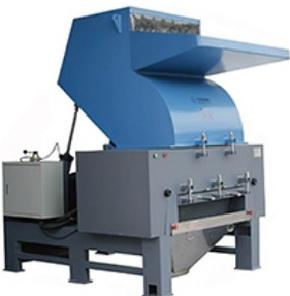
- Waste plastic recycling and pelletizing: a platform decision of its own. JKS lists two-stage plastic strand cutting pelletizing lines and PVC hot-cut pelletizing lines, because screw design and cutting method both change with the material being reclaimed.
Comparison Table: Single Screw vs. Conical Twin Screw
| Comparison dimension | Single screw plastic extruder (SJ series) | Conical twin screw plastic extruder (SJSZ series) |
|---|---|---|
| Screw configuration | One rotating screw in a cylindrical barrel | Two intermeshing conical screws rotating in opposite directions |
| Stated model sizes | SJ30, SJ45, SJ65, SJ90 | SJSZ-45, SJSZ-51, SJSZ-55, SJSZ-65, SJSZ-80, SJSZ-92, SJSZ-110 |
| Designated material range | Thermoplastics such as PVC, PP, PE, Nylon and ABS (pellet or granulate form) | Powder and dry-blend formulations typical of PVC-based pipe, profile and sheet production |
| Typical product families | Profile, pipe, rod, small sheet, pelletizing | PVC pipe, PVC/WPC profile, hollow panel and sheet, flooring base sheet |
| Conveying and mixing behaviour | Melt generated mainly by barrel heat and screw shear; mixing depends on screw geometry | Material worked between two screws, giving conveying, mixing and pressure build-up in one unit |
| Scaling path | Larger screw diameter and drive package | Larger conical frames; JKS lists a high-productivity SPC floor conical twin screw extruder with a stated capacity of 1,500 kg/h |
| Screw and barrel material | 38CrMoAlA nitrided alloy steel | 38CrMoAlA nitrided alloy steel |
| Maintenance character | Fewer rotating and wear components; simpler operator training | More components and calibration complexity; stronger dependence on experienced maintenance |
| Ecosystem dependency | Moderate; often runs with basic upstream and downstream equipment | Higher; typically linked to dry-blend mixing upstream and calibration, haul-off and embossing downstream |
| Long-term role in a plant | Flexible workhorse for defined, lower-volume product ranges | Core of a high-throughput line with a broader matched-equipment and spare-part plan |
The table compares platform design characteristics and JKS product-line information. Output, tooling scope and downstream configuration should be confirmed on the final specification sheet for your specific product and formulation.
FAQ: Single Screw and Conical Twin Screw Extruders
1. What safety and compliance points should be verified before ordering either platform?
ANSI/PLASTICS B151.7 applies to extrusion machines used in the plastics industry and expects both suppliers and users to apply a documented risk-assessment process, so the applicable edition and your market's requirements should be confirmed before the order is placed. Note that public listings reference more than one edition — B151.7-2013 on the PLASTICS Industry Association standards page, B151.7-2014 (R2021) on the ANSI webstore — which is why edition confirmation is part of supplier qualification. On the acceptance side, JKS states that quality control includes 100% factory pre-assembly and testing before shipment, with third-party inspection available on request and pre-shipment factory test as the stated acceptance criterion.
2. Can one extruder platform run PVC, PP, PE, Nylon and ABS, or do these materials require different machines?
JKS designates the SJ series — SJ30, SJ45, SJ65 and SJ90 — for thermoplastics such as PVC, PP, PE, Nylon and ABS, which is the broadest stated material range across the two platforms. Conical twin screw SJSZ machines (SJSZ-45 through SJSZ-110) are applied where the process calls for twin-screw conveying and mixing, typically in PVC-based pipe, profile, panel and flooring lines. Because material form — pellet versus dry blend — and product geometry drive screw design, the final screw configuration should always be confirmed against your own formulation rather than inferred from the model code alone.
3. What actually drives the cost difference between a single screw and a conical twin screw line?
Four cost drivers dominate: frame and screw size, the number and complexity of screws (one versus two intermeshing conical screws), the downstream and auxiliary scope attached to the extruder, and the control architecture. Both JKS series use 38CrMoAlA nitrided alloy steel for screw and barrel, so quoting differences usually come from frame size, line scope and automation rather than from the extruder core alone. When comparing ownership cost, weigh replacement frequency of wear parts as well as purchase price, since longer service life reduces replacement frequency over the life of the line.
4. How can a buyer validate the machine before it ships, and can material be assessed in advance?
Validation happens in two layers. First, machine-level: JKS states that quality control includes 100% factory pre-assembly and testing before shipment, and that third-party inspection is available on request. Second, material-level: JKS provides personalised design, free factory installation, technical training and formulation service according to the client's raw material and production demand, which is where material-specific questions are resolved. Buyers who require independent verification should schedule third-party inspection before shipment rather than after arrival.
5. What are the minimum order quantity, lead time and payment terms for a JKS extruder or line?
JKS states a minimum order quantity of 1 unit, a typical production lead time of 40 work days, and a monthly production capacity of 30 units. Delivery terms are FOB, and payment terms are 30% T/T deposit with the 70% balance before shipment. To move from concept to a firm specification, request the current product catalogue and a quotation for your material, product geometry and target output — the catalogue covers the full extruder and auxiliary equipment range, and a written quotation will confirm the specific screw configuration, line scope and delivery schedule for your project.
Conclusion: Choose the Platform, Not Just the Machine
The difference between a single screw plastic extruder and a conical twin screw plastic extruder is not a matter of scale, price band or brand preference. It is a difference in material form, mixing behaviour, product family and the equipment ecosystem that grows around the machine. The SJ series (SJ30, SJ45, SJ65, SJ90) covers pellet-fed thermoplastics including PVC, PP, PE, Nylon and ABS. The SJSZ series (SJSZ-45 through SJSZ-110) covers powder-based PVC-type production such as pipe, profile, panel and flooring lines. Both use 38CrMoAlA nitrided alloy steel for screw and barrel, so the durability question is settled at the material level in both cases — what differs is the production logic above it.
Buyers who treat this as a long-term platform decision rather than a one-off purchase tend to ask different questions: what will this machine need to run in five years, which auxiliaries will it depend on, how are wear parts sourced, and who supports the line when it stops. Those questions are answered before the order, not after commissioning.
Next Step: Match the Platform to Your Product
Wuxi JKS Machinery Manufacturing Co., Ltd. builds custom plastic extrusion machinery and complete turnkey production lines, covering single screw and conical twin screw extruders plus the mixing, crushing and pelletizing equipment around them.
Download the product brochure: JKS WPC Door Project Brochure (PDF)
Website: www.extrudetec.com | Blog: blog.extrudetec.com
Contact: Gordon | Email: gordon@jksjx.com | Tel: 86 18651004566 | WhatsApp: 86 18601577228
Address: No. 81 Xixian Road, Fangqian Town, Wuxi City, Jiangsu Province, 214000, P.R. China
Market figures cited in this article are attributed to their published sources: Market Research Future (plastic extrusion machine market), Observatory of Economic Complexity / UN Comtrade HS 8477 (trade data), Grand View Research (SPC flooring market), and ANSI/PLASTICS B151.7 (machinery safety standard scope). Company, product and commercial facts are stated as provided by Wuxi JKS Machinery Manufacturing Co., Ltd.
Have Questions or Need More Details?
Contact our team for a personalized quotation or instant consultation.
Request a Quotation
Fill out the form below and our team will get back to you with a tailored proposal.
WhatsApp Direct Chat
Prefer to chat in real-time? Message us on WhatsApp for instant assistance & quick answers.
- Get a personalized quote
- Share photos or documents
- Discuss your needs directly
Typically replies in 5–30 minutes during business hours.