
Does Your Extrusion Machine Supplier Cover the Whole Line?
A supplier can quote a perfectly serviceable extruder and still leave you buying the mixer, the crusher, the pulverizer and the pelletizing line from three other companies. That is not a machine problem — it is a scope problem, and in most projects it surfaces during installation, weeks after the purchase order was signed.
This guide answers one question for buyers who have moved past shortlisting and into evaluation: when a plastic extrusion machine supplier says it covers upstream and downstream equipment, what evidence should actually exist? Wuxi JKS Machinery Manufacturing Co., Ltd. — the manufacturer behind JKS Plastic Extrusion Machine, founded in 2013 in Wuxi, Jiangsu, and exporting to more than 35 countries — publishes model-level ranges across four process blocks. That makes the scope question testable rather than rhetorical, which is exactly what an evaluation-stage buyer needs.
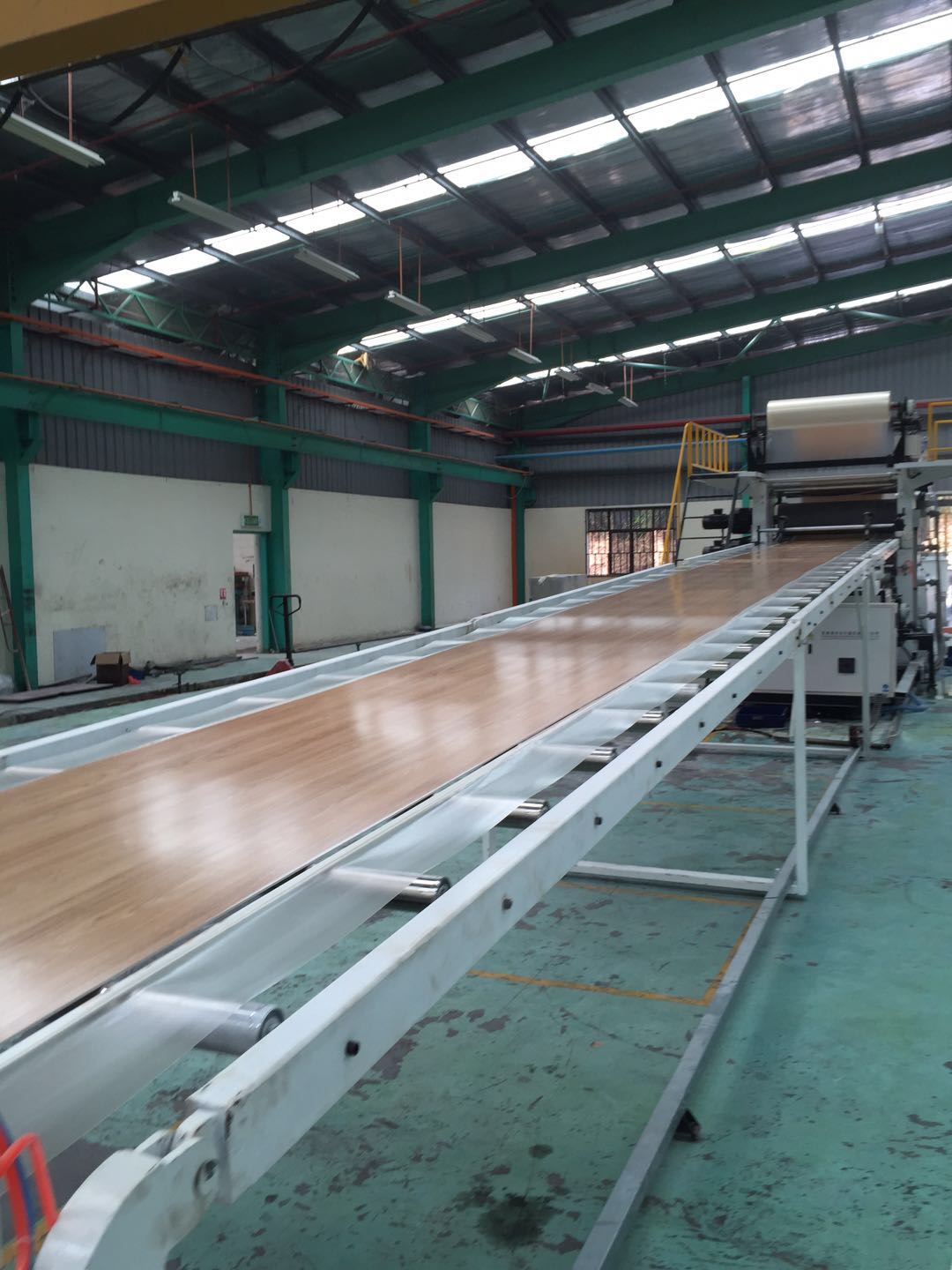
An SPC flooring extrusion line running at a customer site. Scope coverage is judged on the whole chain, not on the extruder alone.
What “Upstream and Downstream” Means in an Extrusion Audit
Before you compare suppliers, split your own line into three blocks. The split is a procurement tool, not an engineering classification, and it lets you see exactly where a quotation stops.
- Upstream — material preparation. Mixing and cooling, size reduction (crusher, pulverizer), and compounding or reclaim (pelletizing).
- Core — extrusion. The extruder itself, with its screw and barrel configuration.
- Downstream — post-extrusion. The forming, calibration, haul-off, cutting and handling section of the specific product line, plus the auxiliary units that support it.
A supplier that covers only the middle block is a machine vendor. A supplier that covers all three is a process-chain vendor. The practical difference is not the length of the catalogue — it is who owns the interfaces between blocks.
Why the interface, not the machine, is where projects slip
An extruder is rarely the weakest link in a new line. The weak links sit between units that were bought separately. Three examples recur in extrusion projects:
- The mixer's output feeds the extruder. If two companies own those two units, the dry-blend specification becomes a shared excuse when output falls short of expectation.
- Regrind from the crusher and pulverizer re-enters the formulation. If the size-reduction unit comes from a third party, no one owns the regrind ratio in the recipe.
- Commissioning, training and the warranty route multiply with every additional supplier on site.
The evaluation question therefore becomes: can this supplier document each block with a model, and can it name the party responsible for the boundary between blocks?
Why the Scope Question Is Being Asked More Often
The commercial context explains why “we can supply everything” has become cheaper to say. A commercial research projection from Market Research Future (published September 2026) puts the global plastic extrusion machine market at USD 7.901 billion in 2025, rising to USD 12.87 billion by 2035. That is a forecast from a commercial research house, not audited industry data, but it describes a market large enough to contain a very long tail of suppliers.
Trade data points the same way. According to the Observatory of Economic Complexity, using UN Comtrade data, China was the leading exporter of rubber and plastic working machinery (HS 8477) in 2024 at USD 8.55 billion, ahead of Germany at USD 6.11 billion and Italy at USD 2.61 billion. A deep, competitive export base is good for buyers on price — and harder for buyers to differentiate on capability.
That is the point of asking for model-level scope. Adjectives are cheap; a model designation, a stated screw material and a certificate number are not. They can be checked against a drawing, a material certificate or a covered-model annex, and they can be written into a contract.
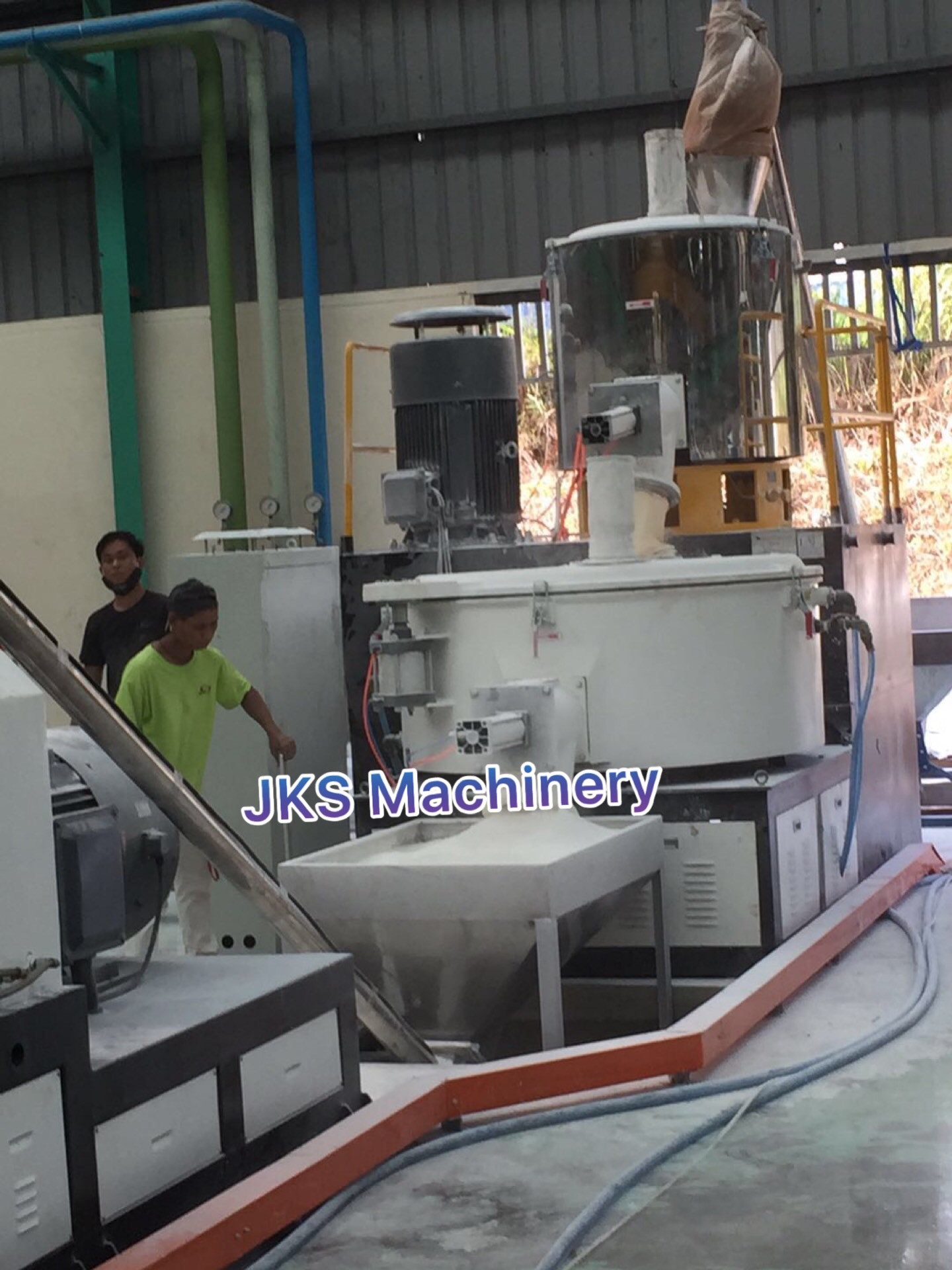
Upstream block in operation: a mixing unit preparing compound ahead of the extruder on an SPC flooring line.
The Portfolio Test: What JKS Documents, Model by Model
JKS operates a 2,000 m² workshop with a six-engineer R&D team, states a monthly production capacity of 30 units and a typical lead time of 40 working days, and reports a 50% export ratio across Southeast Asia, Russia, the Middle East, Europe, Central Asia, Africa and South America. Those figures describe a mid-sized specialist, not a trading house. The more useful test, though, is whether the published portfolio can be mapped to the four process blocks without guesswork.
| Process block | Equipment family | Documented model range | What the list lets you verify |
|---|---|---|---|
| Upstream — mixing | PVC Mixing & Cooling Unit | SRL-Z200/500, SRL-Z300/600, SRL-Z500/1000, SRL-Z1000/3000 | Whether a batch size close to your recipe exists, and which unit mates with your extruder |
| Upstream — size reduction | Plastic Crusher | SP400 / SP660 | Whether regrind capacity matches your scrap rate |
| Upstream — size reduction | Plastic Pulverizer | MF400 / MF500 / MF600 | Whether pulverized regrind can return to the formulation |
| Upstream — compounding / reclaim | Strand Cutting Pelletizing Line | ST80, ST100, ST120, ST150 | Which pelletizing route was specified, and why |
| Upstream — compounding / reclaim | PVC Hot-cut Pelletizing Line | SJSZ55, SJSZ65, SJSZ80, SJSZ92 | Whether the pellet route shares the extruder family with your main line |
| Core — extrusion | Conical Twin Screw Plastic Extruder | SJSZ-45 / 51 / 55 / 65 / 80 / 92 / 110 | Whether the extruder in each product line traces back to a common platform |
| Core — extrusion | Single Screw Plastic Extruder | SJ series: SJ30, SJ45, SJ65, SJ90 and custom models | Whether low-output or specialty duty is served by a separate family |
| Downstream — product lines | SPC Flooring, pipe, profile, panel, sheet, rod, formwork lines | e.g. SPC: SJSZ92/188 (110 kW), SJSZ110/220 (200 kW), SJP115/30 (90 kW), SJP135/30 (132 kW) | Whether the upstream block you are buying actually connects to a line the supplier builds |
Upstream block: mixing, crushing and pulverizing
The mixing and cooling family runs from SRL-Z200/500 to SRL-Z1000/3000, a four-step range, with a stainless steel mixing pot stated in the product data. Size reduction is covered on two fronts: the Plastic Crusher in SP400 and SP660, with a wear-resistant steel chamber and blades stated, and the Plastic Pulverizer in MF400, MF500 and MF600. Two crusher sizes and three pulverizer sizes are not a marketing list — they are the numbers you need to hold a conversation about your scrap rate and your target regrind ratio.
Reclaim and compounding: two pelletizing routes
Pelletizing is offered by two distinct routes rather than one. The Plastic Strand Cutting Pelletizing Line covers ST80, ST100, ST120 and ST150; the PVC Hot-cut Pelletizing Line covers SJSZ55, SJSZ65, SJSZ80 and SJSZ92. In simple terms, strand cutting extrudes strands that are cooled and then cut, while hot-cut pelletizing cuts the melt at the die face. Which route suits you depends on the material and on what the pellet will be used for, and that is precisely the question to put to the supplier rather than resolve from a catalogue page.
Core block: two extruder families, cross-checked
The core is covered by a conical twin screw family — SJSZ-45, 51, 55, 65, 80, 92 and 110 — and a single screw family, the SJ series, spanning SJ30, SJ45, SJ65 and SJ90 with custom models available. The audit value here is the cross-check: the product lines in the portfolio are built on these two families, so the model list of the lines and the model list of the extruders can be read against each other. If a line model does not trace back to an extruder platform the supplier actually lists, that is a question worth asking before the deposit, not after.
Downstream block: the product lines themselves
The downstream evidence is breadth with model numbers attached:
- SPC flooring: SJSZ92/188 (110 kW), SJSZ110/220 (200 kW), SJP115/30 (90 kW), SJP135/30 (132 kW).
- Pipe: PVC water supply and drainage PVC63, PVC250, PVC630; HDPE water pipe PE110, PE315, PE630, PE1000, PE1600; PPR pipe PPR20-75 and PPR20-110; corrugated KSPG-63, KSPG-32, KSPG-20, KS-160, KS-75; steel wire mesh reinforced GS/PE-160-H through GS/PE-630-H.
- Profile and panel: PVC hollow wall panel and ceiling SJSZ51, SJSZ55, SJSZ65, SJSZ80; PVC & WPC door and window profile SJSZ92/188 and SJSZ65/132; WPC door panel SJSZ80 and SJSZ92; PVC grille and decoration profile SJSZ51 (18.5 kW), SJSZ55 (22 kW), SJSZ65 (37 kW); multi-material profile SJ45, SJ50, SJ65.
- Sheet and board: PVC & WPC foam board SJSZ80/156 (75 kW) and an 80+165 co-extrusion configuration (75+37 kW); PVC imitation marble sheet SJSZ80/156 (75 kW) and SJSZ92/188 (110 kW).
- Rod and formwork: solid plastic rod SJ45 and SJ65; PP hollow construction formwork SJ-130×33 (160 kW) and SJ-90×33 (75 kW).
Stated materials as checkable signals
Materials are where a portfolio stops being a list and becomes evidence. The product data states 38CrMoAlA nitrided alloy screws and barrels, carbon steel frames, a stainless steel mixing pot, and a wear-resistant steel chamber and blades on the crusher. Each of those is falsifiable in a way that “high quality” is not — a grade designation and a heat treatment can be checked against a drawing callout and a material certificate.
Turn each into an audit request: ask for the screw and barrel drawing with the material and nitriding specification called out; ask which parts are classified as wear consumables and how they are replaced; ask which stainless grade is used in the mixing pot; ask for the frame drawing and the welding inspection step. A supplier who can answer these quickly is describing a real build process. A supplier who answers with adjectives is describing a brochure.
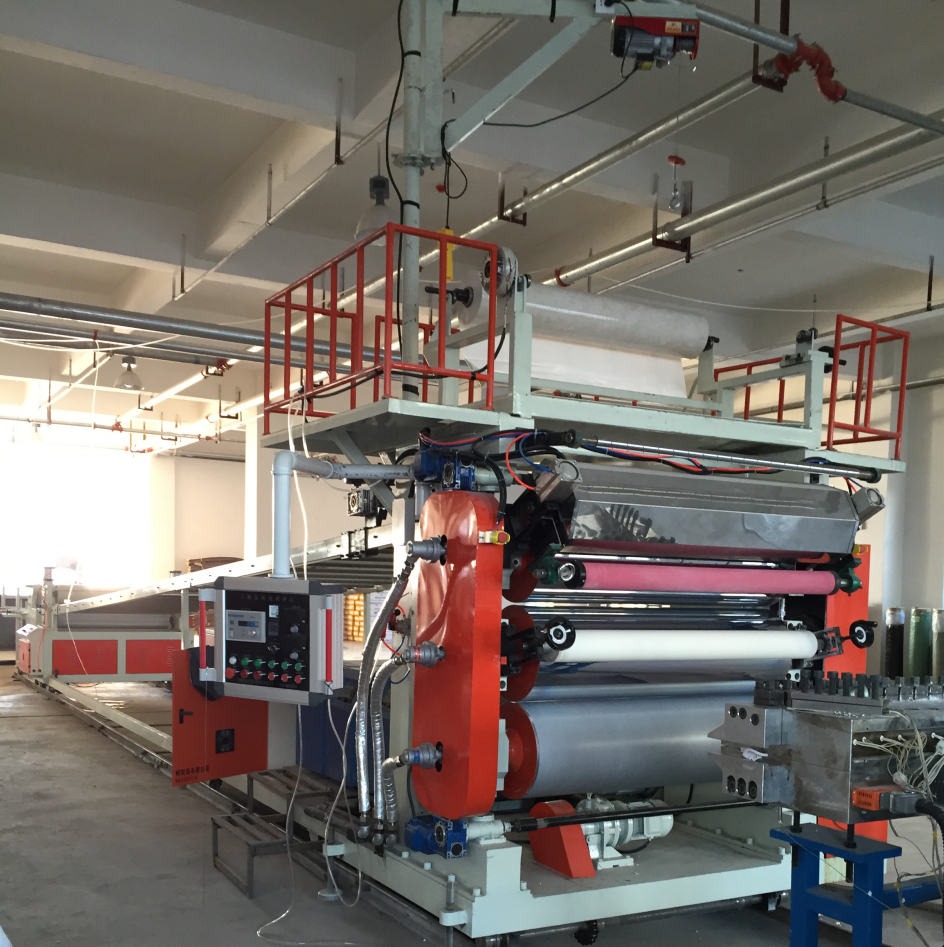
Workshop view of a flooring extrusion line. Breadth in a catalogue should be matched by what can be seen and documented on the floor.
What Breadth Does Not Prove
A wide portfolio proves range. It does not automatically prove five other things, and an honest evaluation separates them.
- It does not prove equal depth in every unit. The SPC flooring line family and the pelletizing routes are not the same engineering problem, and a buyer should weight evidence by the block that carries the most risk in their project.
- It does not prove every unit is built in the same workshop. Ask for the make / buy / integrate split in writing. Many suppliers build the extruder and integrate partner-built auxiliaries; that can be a perfectly sound model, provided the interface and warranty responsibility are named.
- It does not turn a stated capacity into an audited one. Thirty units per month and a 40-working-day lead time are supplier-stated figures. Treat them as planning inputs, and consider a third-party inspection if the schedule is critical.
- It does not automatically extend a certificate's scope. The CE certificate held for these machines — number M.2021.206.C.64011, issued by UDEM International Certification Auditing Training Centre — states its scope as plastic extrusion lines including the SJSZ, SJ and SJP series models, assessed against EN ISO 12100:2010, EN 1114-1:2011, EN 60204-1:2018 and the listed EMC standards. The wording is by line series, so if you bundle a mixer, crusher, pulverizer or pelletizer into the order, ask whether each unit appears in the covered-model annex, and confirm the certificate's validity at the date of your audit.
- It does not settle which safety edition applies to you. ANSI/PLASTICS B151.7 applies to extrusion machines used in the plastics industry and calls for a documented risk-assessment process in manufacture, care and use. Published references to this standard appear in more than one edition, so confirm the edition your market requires instead of assuming the one in a quotation annex.
A Seven-Step Audit You Can Run in Two Weeks
- Draw your own block diagram first. Mark where material enters, where melt is formed, and where finished product leaves. Most scope disputes are visible on one page.
- Convert categories to models. Ask for the exact model proposed for each block — mixing unit, crusher, pulverizer, pelletizer, extruder, product line — rather than accepting a family name.
- Request the build-scope split. Three columns: built in-house, built to the supplier's design by a partner, integrated third-party. Assign a name to each cell.
- Assign interface ownership. Write down who owns mixer-to-extruder matching, regrind reintroduction, and utilities connection. This is the single most useful page in the file.
- Verify materials against documents. Match stated screw and barrel grade and treatment, frame material and pot material to drawings and material certificates.
- Verify compliance scope and edition. Check the certificate annex against the actual models ordered, and confirm which safety standard edition your destination market applies.
- Fix acceptance criteria and link payment to them. Pre-shipment factory testing, test record items and third-party inspection rights should be agreed before signing, not negotiated at the loading dock.
How the Scope Question Changes by Plant Type
SPC flooring plants
SPC flooring is the most scope-hungry of the common lines, because it depends on a continuous dry blend, runs at high output, and generates its own edge trim. The documented evidence base is strong here: a complete SPC flooring extrusion line at a Malaysian manufacturer has been in stable operation for more than 10 years, producing flooring for residential and commercial use, with high-speed production, precise thickness control, and on-site installation and training support. A second complete line at a South Korean flooring manufacturer has run for more than 8 years, achieving 24/7 production with consistent product quality, low maintenance rate, high output, precise thickness control and reliable after-sales support. Both projects are recorded against the SPC flooring line family — SJSZ92/188, SJSZ110/220, SJP115/30 and SJP135/30.
For this plant type, the evaluation question is not “which extruder” but “who owns trim return and regrind re-entry”. If the answer spans three suppliers, the formulation becomes unmanaged.
PVC, PE and PPR pipe plants
Pipe plants live or die on dry-blend quality and on regrind economics. The portfolio covers the pipe side in model detail — PVC63, PVC250 and PVC630 for water supply and drainage; PE110 through PE1600 for HDPE water pipe; PPR20-75 and PPR20-110; KSPG and KS series for corrugated; GS/PE-160-H to GS/PE-630-H for steel wire mesh reinforced composite pipe. Upstream, the same supplier lists the mixing and cooling unit, crusher and pulverizer, which means the regrind loop can be specified in one conversation rather than three.
Profile, panel and board plants
For panel and profile producers the chain question is about changeover discipline as much as throughput. A Vietnamese plastic building materials manufacturer has run a complete PVC hollow wall panel extrusion line for more than 5 years, producing panels for construction and interior decoration, with stable continuous production, consistent product quality and reliable performance; the project record cites a complete turnkey solution, on-site installation support and full export documentation. That line family is documented as SJSZ51, SJSZ55, SJSZ65 and SJSZ80, sitting on the same conical twin screw platform as the pipe and flooring families — which is the practical meaning of “one platform, many product lines”.
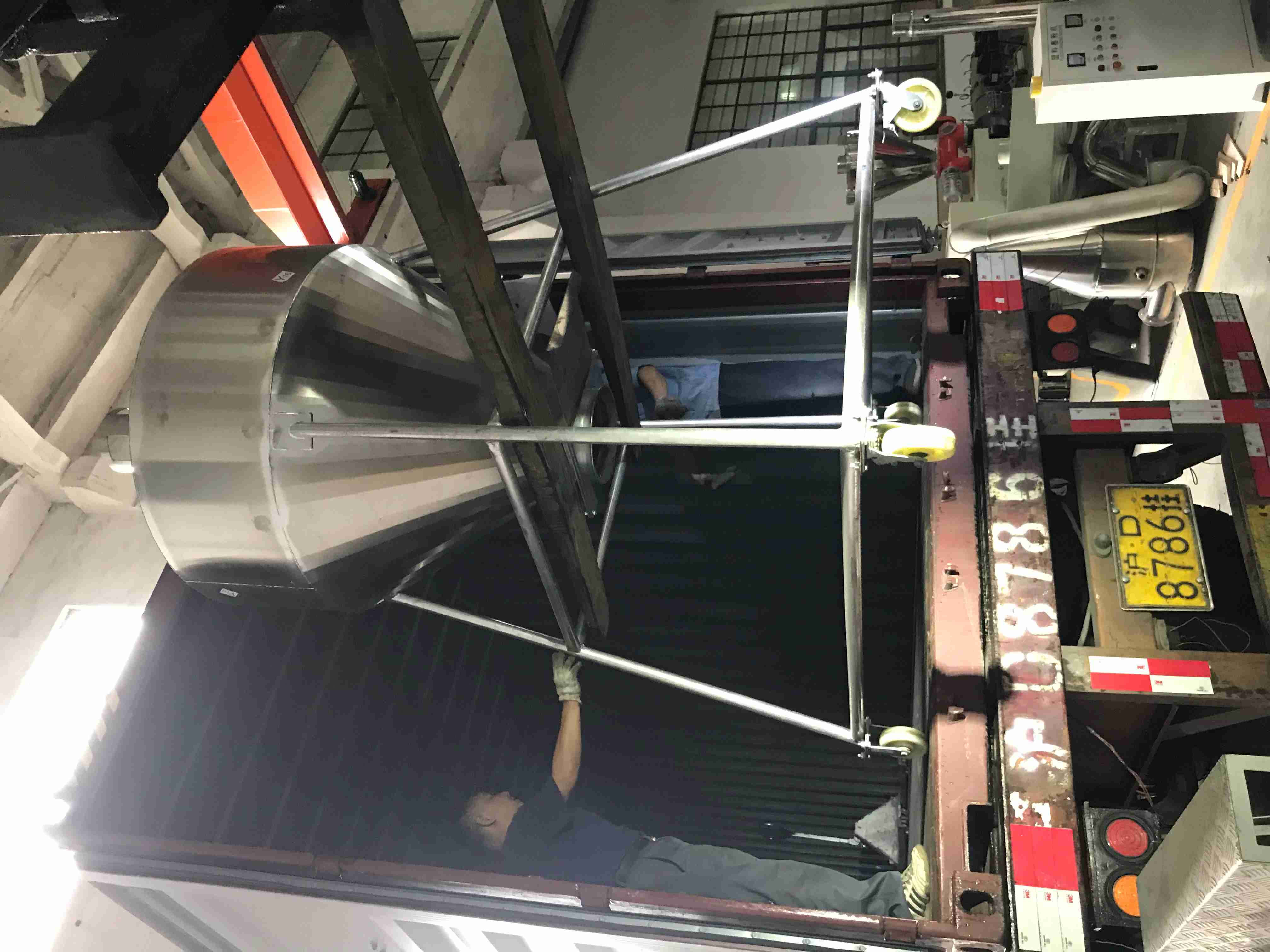
Auxiliary equipment loaded alongside a main line. Scope coverage should be visible in packing lists, not only in the quotation.
Delivery Assurance: What to Settle Before You Sign
Scope questions are cheap during evaluation and expensive after the deposit. Group the remaining questions into three blocks and get written answers.
On scope split
- Which units in this order are built in your workshop, which are built to your design by a partner, and which are integrated third-party units?
- Does the packing list enumerate every auxiliary unit, or only the main line?
- Who prepares export documentation for the full consignment?
On line integration
- Who owns the interface between the mixing unit and the extruder, including the compound specification?
- Is the crusher and pulverizer sized against our actual scrap rate, and who confirms the regrind ratio?
- Which drawings will we receive before shipment — general arrangement, electrical schematic, screw geometry?
On acceptance and commercial terms
- The stated commercial basis is MOQ 1 unit, delivery terms FOB, and payment of 30% T/T deposit with the 70% balance by T/T before shipment.
- The stated acceptance criterion is a pre-shipment factory test. Quality control is described as 100% factory pre-assembly and testing before shipment, with third-party inspection available on request — confirm the test record items now.
- Typical production lead time is 40 working days, with stated monthly capacity of 30 units. Check that your delivery window matches, especially where several blocks are ordered together.
- After-sales scope is stated as overseas installation guidance, on-site commissioning, operator training, remote technical support and a 12-month warranty; the company profile additionally lists factory installation, technical training and formulation service.
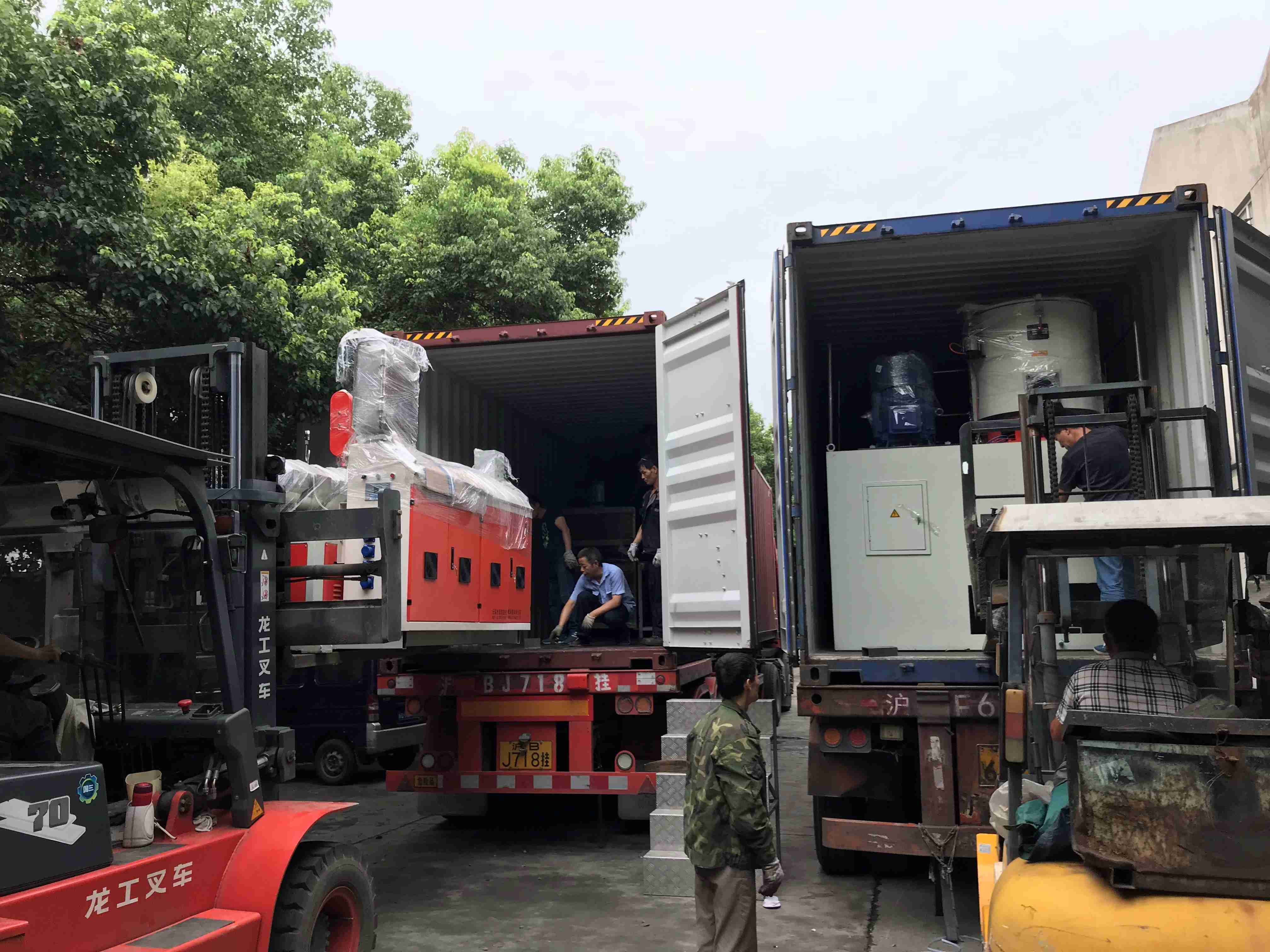
Loading a complete line. Agree the acceptance record before this point, not after it.
FAQ
Does the CE certificate cover the auxiliary units as well as the extruder?
The CE certificate held for these machines — number M.2021.206.C.64011, issued by UDEM International Certification Auditing Training Centre — states its scope as plastic extrusion lines including the SJSZ, SJ and SJP series models, assessed against EN ISO 12100:2010, EN 1114-1:2011, EN 60204-1:2018 and the listed EMC standards. Because the scope is written by line series, the practical step is to request the covered-model annex and check whether each mixer, crusher, pulverizer or pelletizer in your order appears on it, and to confirm the certificate's validity at the date of your audit.
Can one supplier genuinely cover mixing, crushing, pulverizing and pelletizing, or does it resell them?
The test is the model list plus the build-scope split. JKS documents the PVC Mixing & Cooling Unit in four steps (SRL-Z200/500, SRL-Z300/600, SRL-Z500/1000, SRL-Z1000/3000), the Plastic Crusher in two (SP400, SP660), the Plastic Pulverizer in three (MF400, MF500, MF600), and pelletizing by two routes — strand cutting (ST80, ST100, ST120, ST150) and PVC hot-cut (SJSZ55, SJSZ65, SJSZ80, SJSZ92). A model list shows range; the make / buy / integrate split shows who is responsible when a unit fails. Ask for both in writing.
How much of a line can be customized to our material and layout?
JKS states OEM, ODM and custom design production services, with customization covering extruder model, screw configuration, production line layout, voltage and frequency, control system, and capacity adjustment. In an evaluation, convert each item into a document you will receive before shipment — a general arrangement drawing, an electrical schematic and a screw geometry drawing — so that customization is verifiable rather than verbal.
What are the purchasing terms for a complete line?
The stated terms are: MOQ 1 unit; delivery terms FOB; payment of 30% T/T deposit with the 70% T/T balance before shipment; and acceptance criteria based on a pre-shipment factory test. Because a complete line may span several process blocks, confirm that the terms apply to the whole consignment rather than to the main machine only.
How is the equipment validated before it leaves the factory?
Quality control is described as 100% factory pre-assembly and testing before shipment, with third-party inspection available on request, and the pre-shipment factory test is the stated acceptance criterion. In practice, ask for the test record template in advance so you know which parameters will be logged, who signs, and how a third-party inspector will be granted access.
What lead time and after-sales support should we plan for?
Typical production lead time is 40 working days, against a stated monthly capacity of 30 units. After-sales support covers overseas installation guidance, on-site commissioning, operator training, remote technical support and a 12-month warranty, and the company profile also lists factory installation, technical training and formulation service. The Vietnam panel-line project record additionally cites full export documentation as part of the delivery scope. If you are assembling a full process chain for the first time, the catalogue download below is the fastest way to start the model-matching conversation.
Conclusion
The useful question in a supplier evaluation is not whether a company can sell you an extruder. It is whether it can put a model number, a material specification and a certificate annex behind every block of your process chain — and then tell you honestly which blocks it builds, which it integrates, and who signs off the boundary between them.
JKS Plastic Extrusion Machine documents that chain from mixing unit to pulverizer to pelletizing line to finished-product line, on two extruder platforms, with stated screw and barrel materials that can be checked against drawings. That is enough evidence to run a real audit. Whether the answer holds for your project depends on the questions you put in writing before the deposit — which is why the seven-step audit and the delivery-assurance list above matter more than any single specification.
Next step: review the machine configurations and line layouts in the JKS product brochure (PDF), then send your block diagram and target output for a model-matched scope split.
Contact: Gordon · gordon@jksjx.com · Tel 86 18651004566 · WhatsApp 86 18601577228 · No. 81 Xixian Road, Fangqian Town, Wuxi City, Jiangsu Province, 214000, P.R. China.
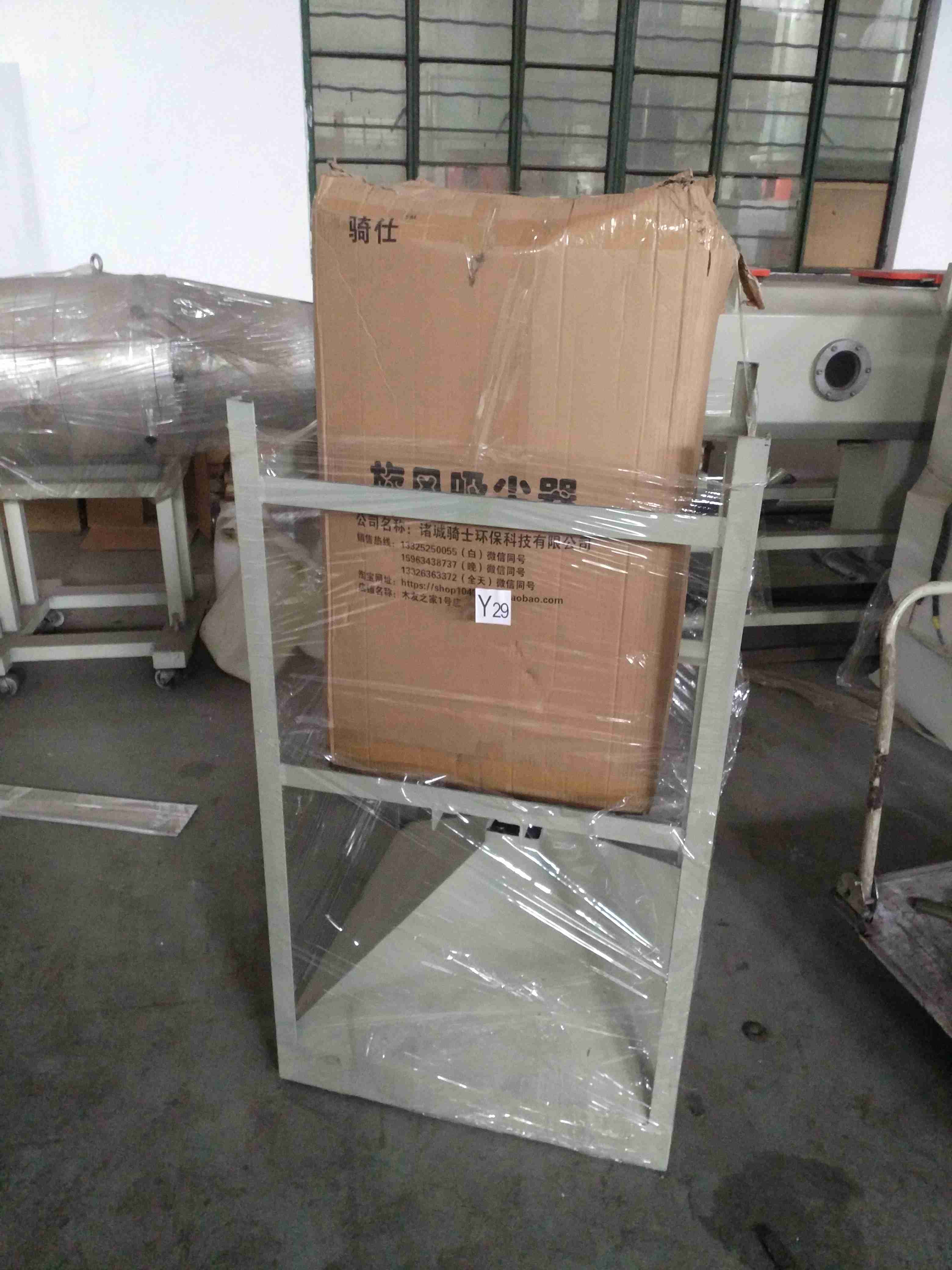
Export packing of a complete line. Ask for a packing list that enumerates every block, not only the main machine.
Have Questions or Need More Details?
Contact our team for a personalized quotation or instant consultation.
Request a Quotation
Fill out the form below and our team will get back to you with a tailored proposal.
WhatsApp Direct Chat
Prefer to chat in real-time? Message us on WhatsApp for instant assistance & quick answers.
- Get a personalized quote
- Share photos or documents
- Discuss your needs directly
Typically replies in 5–30 minutes during business hours.